
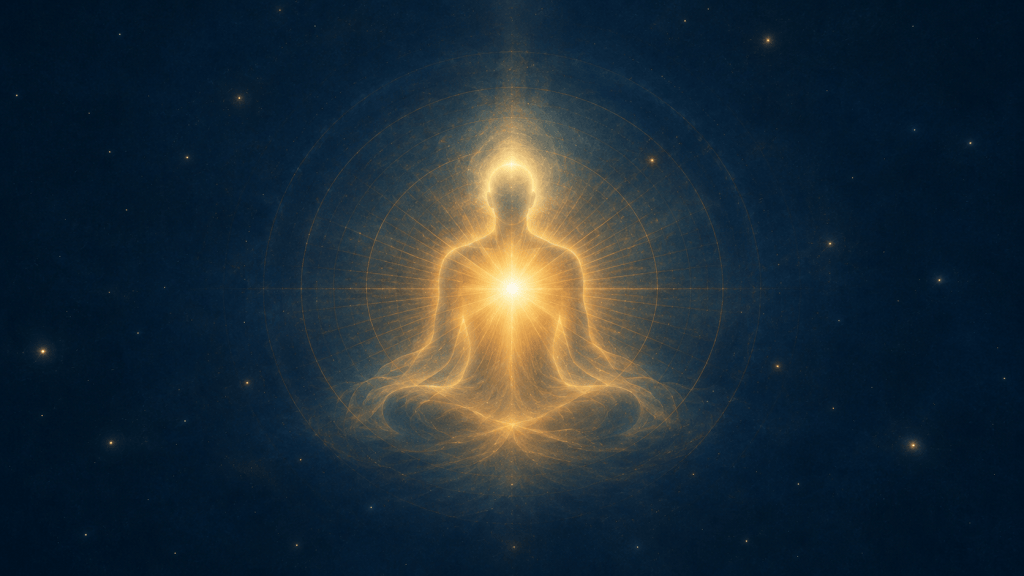
Light and the Inner Life
The word psychic comes from the Greek psyche, which means soul or breath. Before it came to mean mind reading and fortune telling, it meant the inner life of a person: thought, feeling, memory, and the sense of being someone. So when we ask about the psychic nature of man and light, we are asking how the inner life of a person relates to light. Four traditions answer this with remarkable agreement: Kashmir Shaivism, Dzogchen, Sufism, and the teaching of Meister Eckhart. Each says that light is not something the soul looks at. Light is what the soul is.
Kashmir Shaivism: Consciousness as Light
In Kashmir Shaivism, the ultimate reality is Chit, consciousness. The tradition’s word for its nature is Prakasha, which means light. Abhinavagupta, the greatest teacher of the school, says that nothing can be known except by this light. A lamp shows a room, but the lamp itself needs no second lamp to be seen. Consciousness is the same. It shines by itself and reveals everything else.
But the school says light alone is not enough. A mirror also shines, yet it knows nothing. So the tradition pairs Prakasha with Vimarsha, the light’s awareness of itself. Light that knows itself is alive. It is free, it is creative, and it is the source of the world. Everything we see is the play of this self aware light taking form.
What, then, is the psychic nature of a person? The tradition describes a subtle body called the puryashtaka. It is made of mind, intellect, ego, and the impressions left by past experience. This is the psyche in its older meaning. It does not stand apart from the light. It is the light under limitation. The same awareness that is vast appears small when it takes itself to be a separate person. The tradition does not ask us to destroy the psyche. It asks us to recognise what it is made of.
Dzogchen: Luminous Clarity and Emptiness
Dzogchen, the great perfection teaching of Tibet, speaks of the nature of mind in two words: emptiness and clarity. Emptiness means the mind has no solid form that can be found. Clarity, or luminosity, means the mind is not a blank. It knows, it appears, and it is aware. Rigpa, naked awareness, is the union of the two. It is not a state we produce. It is already here, and it only needs to be recognised.
The teachings go further than most traditions in treating light as something that can actually appear. The practice called thögal works with the spontaneous appearance of light, in the form of points, rainbow colours, and patterns. These are said to be the energy of awareness itself, shining outward. They are not made by the practitioner. They are shown by the nature of mind when the conditions are right.
The same teaching governs death. In the bardo of dharmata, the clear light is said to dawn at the moment of dying. It is the bare nature of mind, no longer covered by the body and its habits. A person who recognises it is free. A person who does not recognise it meets visions of peaceful and wrathful forms, and these are said to be the mind’s own projections. The teaching here is plain: what we meet is what we are. The only error is to take it as other.
Sufism: The Light Verse and the Descent of the Soul
In Sufism the image of light is central, and its root is the Light Verse of the Quran: “God is the light of the heavens and the earth.” The verse goes on to speak of a niche, a lamp, and a glass, and it calls the light “light upon light.” Sufi writers have read this as a description of the soul. The lamp is the heart. The glass is the purified self. The light is not the person’s own, yet it shines through the person.
The philosopher Suhrawardi built a whole school on this. He called it the philosophy of illumination. In his teaching, the soul is a being of light that has fallen into matter, and it longs to return to its source. Knowledge is not gathered from outside. It is the soul’s own light becoming clear. Suhrawardi described the world as a series of lights, each one dependent on the one above it, all the way up to the Light of Lights.
Sufi teachers also map the inner life by subtle centres, called the lataif. These are points within the person that are awakened through remembrance of God, or dhikr. Najmuddin Kubra, in the thirteenth century, wrote carefully about the coloured lights that seekers see in this practice. He gave each colour a meaning and a stage. But he, like the other masters, warned that the lights are not the goal. A seeker who stops at the lights has mistaken a signpost for the destination.
Meister Eckhart: The Spark of the Soul
Meister Eckhart, the German Dominican of the fourteenth century, speaks in the language of Christianity, but his teaching meets the others closely. He says there is something in the soul that is uncreated. He calls it the spark, the little castle, the ground. In this place, he says, God and the soul are not two. God does not enter it from outside, because it is already God’s own being.
Eckhart often uses light as the image for this ground. He speaks of a light in the soul that is uncreated and cannot be created. But he does not stop there. He says the ground is finally beyond every image, light included. He calls it a desert, a silence, a place without name. For Eckhart, light is the nearest word we have for something that no word reaches.
His teaching of detachment follows from this. If the ground is already one with God, then the work of the spiritual life is to let go of whatever hides it: images, desires, and the clinging self. What remains is not something new. It is what was always there.
What the Four Share
Set side by side, these teachings agree on several points.
First, light is consciousness itself. It is not an object that consciousness sees. It is the seeing.
Second, the psyche of a person, with its thoughts, memories, and sense of self, is made of this light and does not stand outside it. It appears limited because it forgets what it is.
Third, inner experiences of light are real in the sense that they are reported across cultures and centuries. The traditions do not deny them. Thögal, the coloured lights of dhikr, and the visions of the saints are taken seriously. But all four traditions say the same thing about them: they are signposts, and some are traps. What matters is the one who sees.
Fourth, the path is recognition rather than acquisition. We do not make light. We stop covering it.
The Psychic Nature of Man
So what is the psychic nature of man? On these accounts, it is the meeting place of limitation and light. A person is a shape that awareness has taken, and that shape carries the memory of what it is. This is why people across cultures report moments when the sense of a separate self thins, and something clear and bright is felt at the centre. The traditions did not invent this. They noticed it, named it, and built paths around it.
The task they set is simple to state. Do not chase the lights. Do not despise the psyche. Look at what is looking. There, each tradition says, the light is found, and it is not found as an object. It is found as oneself.



Leave a Reply