
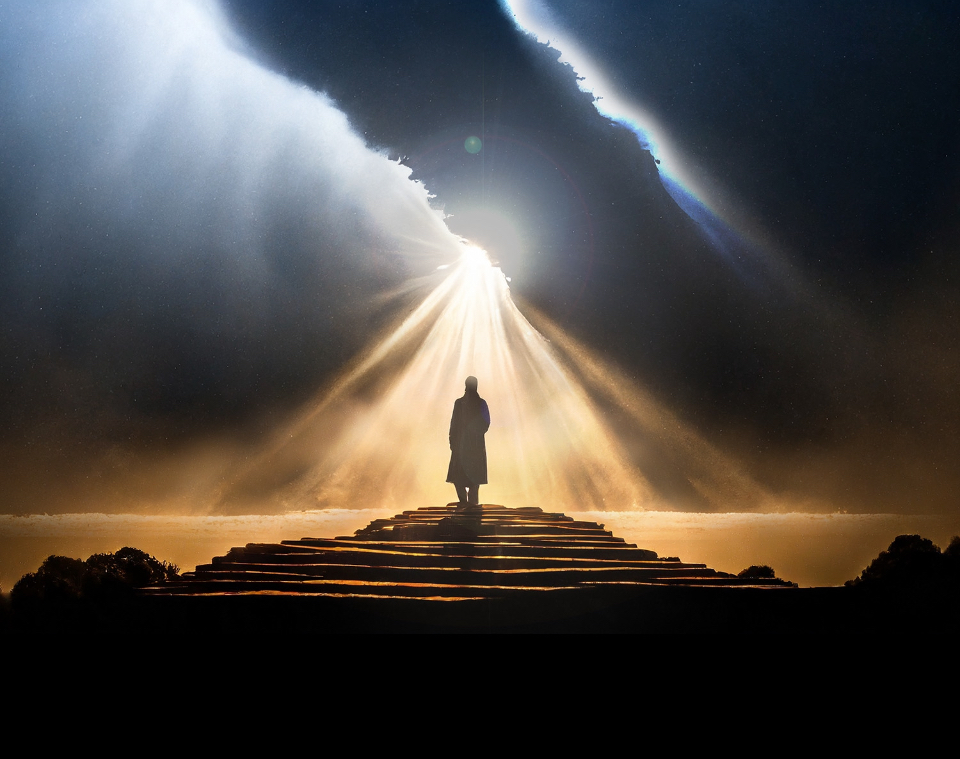
Part One: The Fierce Deity
You have probably seen images of wrathful deities in the Tibetan Buddhist tradition. They are drawn with flames, skulls, and weapons, and at first glance they look like demons. But they are not demons in the way the West imagines demons. They are called dharmapalas, protectors of what is true. Their fierceness is not cruelty. It is compassion taking a form that can cut through delusion when gentleness has failed.
These deities are not separate persons standing outside us, granting favours when called upon. The deeper teaching says they are the qualities of awakened mind given a face and a form so that there is something to meditate on. The fierce clarity of Mahakala is not a power borrowed from elsewhere. It is a quality of awareness that already belongs to the one who invokes it.
Kashmir Shaivism says this even more directly. Kali is not a person to petition. She is a name for the power of consciousness itself, one of the ways the one awareness moves through the world. There is no gap between the deity and the person who embodies her.
This matters most in the moment of being wronged. An energy rises then, the refusal to back down, the demand for what is right, delivered without hatred but without retreat either. This is not an appeal to Mahakala for help. Since the deity is not separate from the person, it is Mahakala’s own activity happening through that person, in that moment, through that particular circumstance.
There is one distinction the tradition insists on. Wrathful energy is compassion, not anger. Anger protects the self. This fierceness protects what is true. It can be calm, even polite, while remaining completely immovable. The test is not how forceful it feels. The test is whether the wrong can be contested without hating the person who did it. When that clarity holds, the fierceness is real. When hatred creeps in, it is only ego borrowing the form.
Part Two: The Cleared Temple
The same pattern appears outside the Vajrayana and Shaivite traditions, in the life of Christ.
When Christ entered the temple and found money changers and merchants trading where prayer should have taken place, he overturned their tables and drove them out. This was not random violence. It was targeted at what had corrupted a sacred space, and it fell on tables and structures, not on people. No one was struck. The force was aimed at restoring right order, not at causing harm.
The same shape appears in his words to the Pharisees, calling them hypocrites, comparing them to whitewashed tombs, clean outside and full of decay within. This is fierceness through speech rather than action, but it follows the same rule. It names a specific failure, using religious authority to control people while neglecting justice and honesty. It is aimed at conduct and hypocrisy, not at condemning the person beyond hope.
There is also the line, I came not to bring peace but a sword. This does not endorse violence. It means that living by these principles creates division, even within families, because truth does not always bring comfort. Standing for what is right will not always keep the peace, and this fierceness does not back down for the sake of comfort or approval.
Even his rebuke of Peter belongs here. When Peter tries to turn him from the path ahead, Christ turns on him sharply, calling him Satan, saying he is thinking as men do, not as God does. This shows the fierceness is not reserved for enemies. It can be turned toward those closest, when they pull one away from what is right, and it comes from care rather than contempt.
Across all these examples, the force is not cruelty. It is aimed at corruption and compromise, not at the worth of the person. The money changers are not cursed as people, the obstruction they created is cleared. The Pharisees are not damned in that moment, what is false in their conduct is named. The sharp words to Peter come from love, redirecting rather than casting out.
This differs from the wrathful deity teaching in one respect. Mahakala’s fierceness is described as one’s own awakened nature taking form, not separate from oneself. Christ’s fierceness in these stories is usually read as divine authority acting through him, a Son enacting his Father’s justice, which keeps a clearer line between the human and the divine than the nondual traditions draw. But the shape of the action is the same in both: protecting truth, refusing to back down, causing no harm to the person while remaining immovable about the wrong.
Part Three: Love Holding Its Ground
None of this fierceness, in Mahakala or in Christ, is a battle between two separate powers. There is one field of being, and what looks like darkness within it is only that same field, briefly unrecognised. Wrath in this tradition is never the one power fighting another. It is the one power meeting its own forgetting and refusing to let that forgetting stand unchallenged.
This is why the fierceness never becomes hatred of the person. The money changers were not cursed as enemies, and Mahakala’s flames do not consume the one who stands before them. Both clear an obstruction so that what was always whole can be seen as whole again. The wrong is confronted precisely, without contempt, because the one confronting it and the one committing it were never, at the deepest level, two.
To stand fierce against injustice, then, is not to take up arms in a war between light and dark. It is to hold the door open, so that what has forgotten itself can find its way home.
Love does not need to defeat darkness, because darkness was never its equal. It only needs to remain love, unmoved, until what is false has nowhere left to hide. Truth does not need to shout, because it was never actually lost. It only needs to be stood in, plainly and without wavering, until what is unclear falls away on its own. And light does not need to conquer contraction. It only needs to keep shining, patiently, until the contraction remembers it was light all along.
This is the final shape of the fierceness we have been describing. Not a force raised against the world, but love holding its ground, until the world remembers what it is.



Leave a Reply