What the Ocean Is Made Of
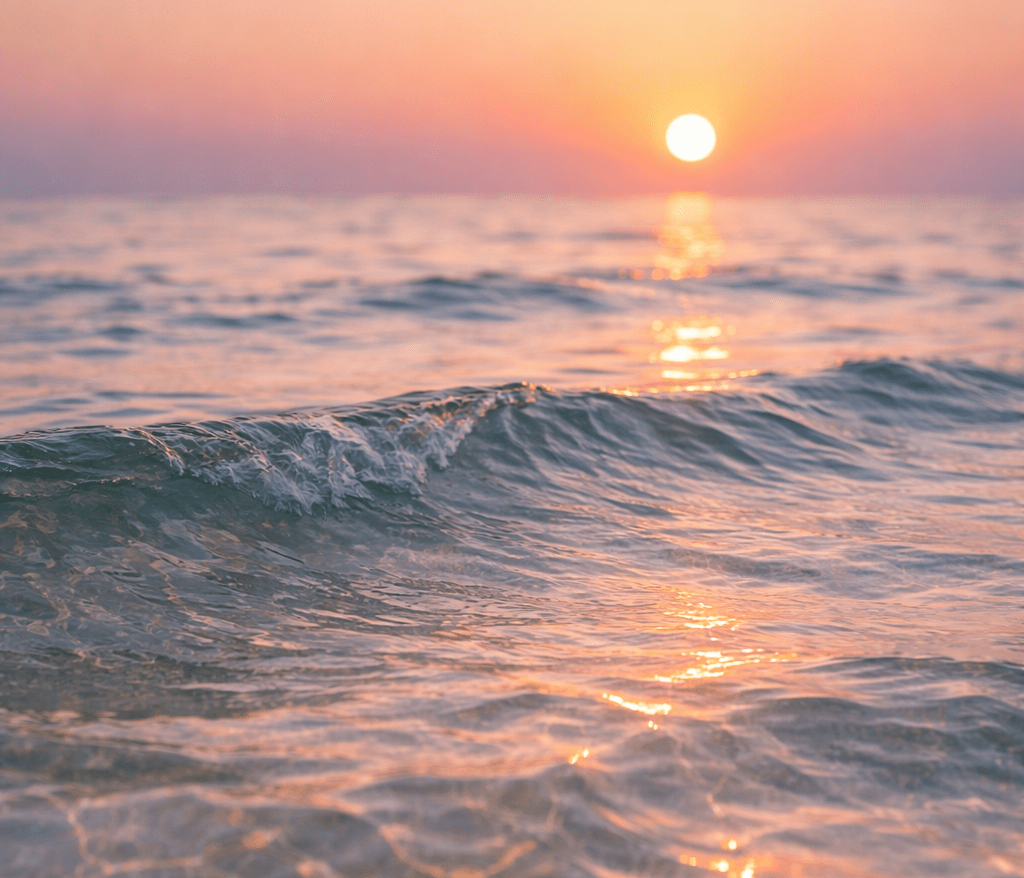
We are all on an ocean journey. Not travellers crossing from one shore to another, but the ocean itself, journeying, appearing for a time as this particular wave, this particular life.
I have written that before. This piece asks the next question. If we are the ocean, moving for a while in a shape called you, then what is the water?
The answer I have come to, after many years, is love.
Not love as a feeling that visits and leaves. Not love as something one person gives another and can withdraw. Love as the substance itself. The water. The thing every wave is made of, before it rises and after it falls, whether it knows what it is or not.
The Wave and the Water
A wave rises. For a time it has a shape no other wave has ever had. It moves, it crests, it falls, and there is ocean again.
At no moment in that whole life was the wave anything other than water. Not partly water. Not water with something else mixed in. Water, entirely, taking a shape for a while.
You are the wave. So is the blackbird in the tree outside the window. So is the tree. So is the light that falls on both of them. Each a real shape, arising, holding, falling. Each made of nothing but the one substance.
And that substance is love.
This is the whole of it. Everything else that follows is an attempt to say the same thing more slowly.
Why This Is Not a Sentimental Claim
When people hear that love is the ground of reality, they often hear something soft. A comfort. A thing said to make grief easier to carry.
I mean something harder than that. I mean it as a description of what exists.
There is one reality. That reality is aware. What we call love is not a mood that reality is sometimes in. It is what that awareness is made of, the way water is what a wave is made of. Remove it and there is nothing left, no wave, no ocean, no world to be sentimental about.
Meister Eckhart said the ground of the soul and the ground of God are one ground. He was tried for heresy partly for saying it plainly. He was not being poetic. He was describing structure.
Not Only Something We Feel
We do feel love. Deeply, and often, and in the body. That feeling is real, and nothing here is meant to make it smaller.
But the feeling is not the whole of what love is. The feeling is what happens when a wave becomes briefly aware of the water. It is the substance, made known to a heart capable of aching and opening.
When the feeling goes, the water does not go. The wave has simply stopped noticing. This is why love can seem to run out, and why it never actually does.
The Sufis distinguish the heart that pumps blood from the heart that knows. Rumi wrote about this second heart constantly, not as metaphor but as an organ of perception in its own right, capable of a knowing that thought cannot reach. When you feel love in the chest, that is not sentiment happening near your ribs. That is the water, recognised.
Why Love Is Always in Short Supply and Never Is
We picture love as a transaction. Two separate people, passing something between them. One gives, one receives. The supply can end.
Almost all our suffering around love comes from this picture. The fear that the other will stop giving. The panic when they do. The sense of being emptied out.
The picture is not cruel. It is simply inaccurate.
If love is the water and not a transaction, it was never scarce. It was never theirs to give you. What they gave you was attention, presence, a mirror. They helped you notice what you already were. That is an enormous gift and it changes nothing about the substance. The water was there before they arrived. It is there after they are gone.
Rabia of Basra, in eighth century Iraq, taught that God should not be loved out of fear of punishment or hope of reward. Love with a condition on it, she said, is not yet love. She was pointing at exactly this. Love that can run out was never the water. It was one wave hoping another wave would keep it afloat.
The Hazelnut
In 1373 a woman in Norwich, gravely ill, was given the last rites and did not die. Instead she saw sixteen visions, and spent the following twenty years alone in a cell attached to a church, writing down what they meant.
In one of them she saw something small enough to hold in a palm, no bigger than a hazelnut. She asked what it was and was told: it is all that is made. She wondered how something so small and so fragile could continue to exist at all.
It lasts, she was told, because it is loved.
I know of no better sentence in the whole of the mystical literature. Not that it is loved by something outside it, watching over it. That it continues to exist because love is what holds it in being. Take away the loving and there is no hazelnut. There is nothing at all.
Julian went further than her century made safe. She wrote that in God there is no wrath whatsoever. None. Not held back, not withheld out of mercy. Simply not there. Everything that happens, including everything terrible, is held inside something that has no capacity for anything but love.
All shall be well, she wrote. And all shall be well. And all manner of thing shall be well.
Why Anything Exists at All
Ibn Arabi, writing in Andalusia and Damascus in the thirteenth century, gave the clearest answer to this I know of, and it is not a philosophical answer. It is a love answer.
He passed on a saying: I was a hidden treasure, and I loved to be known, and so I created the world that I might be known.
Existence, in that sentence, is not an act of power. It is an act of love wanting a mirror. The ocean did not need to become waves. It became waves because love, by its nature, wants to be seen, and there was nothing yet to see it.
Every wave is that wanting, taking a shape. Every creature, every leaf, every human face is the water, looking for its own reflection.
The Reed and the Longing
Rumi opens his great work with a reed cut from the reed bed. The reed is made into a flute. It cries. Every note it plays is the sound of separation from the ground it grew in.
This is the ache at the bottom of a human life. The one that no achievement settles, and no relationship finally answers, and that returns in the quiet after every success.
We usually treat that ache as a problem. Something has gone wrong, we think, and if we found the right person or the right work or the right belief, it would stop.
It is not a problem. It is the wave remembering the ocean. It hurts because the memory is real and the separation is felt, and both of those things are true at once. The longing is the water, calling to itself across a distance that only seems to exist.
Bernard of Clairvaux, a Cistercian abbot writing in the twelfth century, described four stages in this. First we love ourselves for our own sake. Then we love God for what God gives us. Then we begin to love God for what God is. And in the fourth stage, which he thought almost nobody reaches while alive, we love even ourselves only for God’s sake. The small self folded entirely into the larger one.
The wave, learning by degrees that it was always water.
The Bird Did Not Know
One morning many years ago I woke and looked out of a bedroom window at a blackbird sitting in a tree.
The blackbird was the Self. Not a symbol of it. Not a sign pointing toward it. It was the Self, whole, sitting on a branch.
And at the same time it was simply a blackbird. It had no idea what it was. It was experiencing branch, and morning, and its own small song. The whole of the one reality was there, complete, and it had forgotten itself so thoroughly that it could sit in a tree and just be a bird.
I understood, in the same moment, that I was doing the same thing.
This is the fourth principle, seen rather than read. The forgetting is not a mistake. It is what allows a wave to be a wave rather than an ocean pretending to be small. The blackbird’s not knowing was not a failure. It was the condition of its being a blackbird at all.
Thomas Traherne, an Anglican priest whose writings sat undiscovered for two hundred years after his death, described seeing the world this way as a child, the corn, the dust, the sky, all of it lit from within. He called that light love and believed we are taught out of seeing it. The work of a spiritual life, for him, was learning to see it again.
I had practised for twelve years before that morning. The blackbird gave it back to me for a while, without being asked.
In Everything, and More Than Everything
Here is the part that needs care.
Love is entirely present in the blackbird. Not partly. Not a portion of the divine allocated to one small creature. The whole of it, undivided, in a bird the size of a fist.
And love is not limited to the blackbird. It was also the tree, and the light, and the man at the window, and something more besides that none of those contained.
There is always more ocean than there is wave. Even every wave that has ever risen, taken together, does not use the ocean up.
This is why I cannot say that everything simply is God and leave it there. That is true and it is not enough. It flattens what I saw. What I saw was something wholly at home in a small bird and at the same time immeasurably beyond it. Fully here. Never contained.
Ramakrishna, in nineteenth century Bengal, spoke of the divine as a mother, and meant it. Not a distant power to be appeased. An intimacy so close that a child does not think to doubt it. He also went into states where all form dissolved entirely and there was only the one, without shape or name.
Both. The mother close enough to touch. The ocean without a shore. He never chose between them and neither should we.
Why the Self Puts the Little Self Through This
That morning at the window I asked a question without speaking it. If everything is the Self, why does the big Self put the little self through the pain of living?
The answer came as a question of its own.
What would it have been like not to have experienced life?
I did not receive an explanation. I received something better, which was a question to spend a life inside.
Here is what I have come to. The ocean, being everything, could know everything except one thing. It could not know what it is like to be small. To want. To lose. To hold a hand and know the holding will end. To love something that will die.
Only a wave can know that. And so the water forgets itself into waves, and each wave lives an entire life inside a limitation the ocean does not otherwise have, and something is learned that could not have been learned any other way.
Your heartbreak is not a failure of the system. It is the water, finding out what it is made of, from the inside, through you. There was no other way to find out.
How Harm Fits
A wave that crashes and destroys is still entirely water. Nothing foreign has been added to it. It is the same substance, moving without the shape that would let it meet the shore gently.
This is what harm is. Not a second force standing against love. Love’s own energy, moving through a wave that has forgotten so completely that it acts as though what it is crashing into is not also water.
Kashmir Shaivism calls this forgetting anava mala, the sense of being a separate speck. Augustine, from a different tradition entirely, said evil has no substance of its own, that it is a privation, a good twisted out of shape, the way cold is only the absence of heat.
This is not an excuse and it does not soften anything. If anything it makes harm worse, because the person harmed was never other. They were the same water. This is why, in nearly every account of a life review from those who have come close to death, what is described is not judgement handed down from outside. It is feeling directly, for the first time without the fear that drove the act, exactly what one did to another expression of oneself.
The Cost of Saying It
Mansur al Hallaj said it too plainly in tenth century Baghdad. I am the Truth, he said, using one of the names of God. He was executed for it in the year 922.
Eckhart was tried. Julian wrote for twenty years in a cell and her book waited centuries to be read. Traherne’s manuscripts sat unread until the twentieth century.
There is a pattern here, and it is not only about religious authority. It is that this recognition, said plainly, dissolves the distance that most institutions exist to manage. If the water is already in you, there is no gate, and no gatekeeper.
I write this without much fear of execution. But there is still a private version of the same difficulty, which is that most people who have seen this say very little about it, because the words available make it sound either grandiose or mad, and because a wave describing water to other waves is always at a disadvantage.
Living as a Wave
I do not walk around in a state of oceanic bliss. Most days I am a wave with concerns.
This is not a failure. The blackbird did not know what it was, and it sang perfectly well. Traherne’s insight is not that we should live permanently in vision but that the ordinary world, looked at properly, was never ordinary.
What changes is not intensity. It is orientation. Knowing what the water is means loving without needing to secure it. Grieving without believing something has been permanently taken. Meeting another person with the quiet knowledge that they are the same substance wearing a different shape.
The seventh principle is that the return is available now. Not later, not after enough practice, not once you have earned it. Now, because you never left. A wave cannot leave the ocean. It can only stop noticing, and start again.
What Love Is
So, finally.
Love is the water. It is the one reality, and that reality is aware, and what its awareness is made of is love. It is the intelligence that gives shape to a bird, a tree, the earth itself, a human life. It is why anything exists rather than nothing, because love wanted to be known and there was nothing yet to know it.
It is entirely present in the smallest thing and never contained by the largest. It does not run out and cannot be given or withheld, only noticed or missed. It is what you have been reaching for in every person you have ever loved, and what you already are, and have been the whole time, including now, including while reading this.
The blackbird did not know it was made of this.
Most days, neither do I.
But that morning, for a while, at an ordinary window, looking at the most ordinary thing in the world, I did.
Everything is divine loving awareness.
Everything is LOVE.



Leave a Reply