
I went to India because I had to. There is no simpler way to say it. Every obstacle fell away. The pull was that strong.
But that pull had been building for years. Long before India, something was already stirring in me. Questions about the meaning of life, about what lay beneath the surface of ordinary existence. That questioning was there before I had any name for it or any tradition to place it in. It was simply there, growing.
Around that time, in my late teens, training to be a nurse, I found myself drawn to the music of the sixties and seventies, the hippie era, a generation before my own. I had not grown up with it. I was discovering it retrospectively, and something in it spoke directly to that inner questioning. Through a friend I was introduced to the work of Muz Murray, a British mystic and mantra yogi who had wandered the world, lived as a monk in India, and returned carrying something genuinely hard won. His work opened a door I had not known was there.
Around the same time I found Paul Brunton in a library, The Quest of the Overself sitting quietly on a shelf. That led me to A Search in Secret India and others. Brunton was a Western seeker who had gone to the source decades before it became fashionable, who had sat with Ramana Maharshi and brought something of that encounter back in language a Western mind could follow. Through him I began to understand that this current of wisdom ran far back, through generations, through the Victorian era and beyond, deep into the ancient roots of India. Every door led to another door. You could keep going deeper and deeper. That was the nature of it.
Then my friend introduced me to the work of Ram Dass. And that was it. That was when the conscious search truly began. Ram Dass had been Richard Alpert, a Harvard professor, until he went to India and met his teacher Neem Karoli Baba, who gave him a new name and a new direction entirely. His work pointed straight at the heart of the dharma, at the possibility of genuine transformation, and it resonated in a way that went beyond intellectual interest. It felt true. It was his influence, in the late eighties, that moved me to become a nurse for people with disabilities. That is the measure of how real it was. It was not abstract. It changed how I lived.
Through all of this I was practising yoga and meditation, drawn further and further in. The West was growing more aware of these traditions, but that awareness was mostly filtered through a commercialised lens, shaped more by the material culture of the age than by the depths the teachings were actually pointing toward. I had walked that path because something in it resonated with something real in me. But I knew there was more. I could sense the depth of it without yet being able to fully grasp it.
That longing, that yearning for something that could satisfy at the deepest level, is what took me to India. Not restlessness. Not tourism. A pull that would not be argued with.
That changed in Hampi.
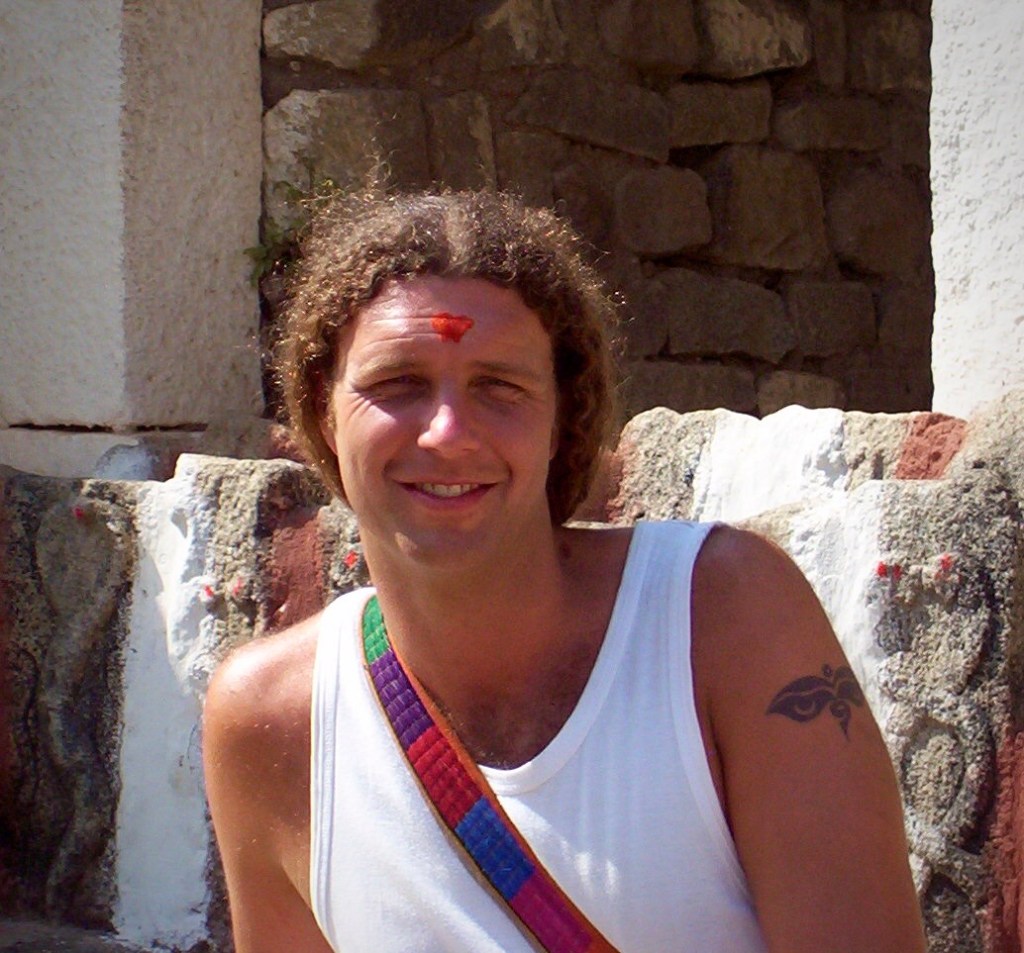
Hampi is an ancient place. The ruins of the Vijayanagara empire rise out of the landscape as though the stone itself remembers something. I was walking slowly through the main temple, moving through its different sections, when a priest approached and placed a tilak mark on my forehead. I bowed, hands together, namaste. It was a deeply moving moment in its own right, to bow in that spirit, to receive that blessing with genuine humility. I carried it with me as I continued through the temple.
As I was making my way out through one of the doorways, a second priest stepped forward and placed another mark on my forehead. My immediate reaction, I will be honest, was a small irritation. I had already received one. Why another? But I recognised that reaction instantly for what it was, the grumbling mind, small and habitual, missing the point entirely. I let it go and accepted the second blessing gracefully.
And in that graceful acceptance something shifted. A warmth arose. A deep happiness and peace, a sense of being held in something larger than the moment. I stepped outside into the sunshine carrying that feeling.
My friend looked at me and said: you have a heart on your forehead.
I did not quite believe it. He took a photograph and turned the camera around so I could see. There on the small LCD screen was the image of me, and clearly, unmistakably, the two thumb marks had merged into a perfect heart shape on my forehead.
That was the first moment of amazement.
Then I looked more carefully at the photograph. Behind me, carved into the ancient rock, twin serpents rose upward through the stone, the symbol that appears across traditions for the rising of awareness through the spine toward the third eye. Heart on the forehead. Serpents rising behind. Everything present in a single image, in a single moment, none of it arranged or sought.
It was not one thing. It was the accumulation, the tilak received with humility, the small resistance released, the warmth that followed, the heart revealed, the serpents behind, all of it arriving together, layer upon layer, until the whole thing cohered into one unmistakable recognition.
In my chest, something opened. The heart expanded, and with it came a quality of knowing I had never quite touched before. Not an idea. Not a conclusion. A recognition. The love felt in the chest and the awareness behind the mind were the same thing. One ground. One reality.
That is chamatkāra.
Not wonder at something exotic or rare. The wonder that arises when any moment becomes transparent, and through it, the living reality beneath everything is directly known.
And here is what I want to say most, the real reason for telling this story at all.
What was revealed in that moment is beyond Indian culture. It is beyond any culture. And yet it is in all cultures, in all people, in all situations, both holy and unholy. There is nothing that can contain it or limit its presence. It can shine through anything, in any circumstance, and it speaks to each person in the language of their own life.
It took me years of practice, a journey across the world, a temple in southern India. For someone else it might be a piece of music. A conversation. A moment of grief. Something seen at the kitchen window on an ordinary morning. The circumstances are entirely different. The moment itself is always the same.
People have been having this moment throughout human history. It is what moves through great poetry and art and love. It stops you somewhere you did not expect to be stopped. It arrives uninvited and leaves you changed, even if you cannot say exactly how or why.
For those who have not had this experience, the natural question is: how can that be? That is a good question. It deserves to be asked. But the asking does not invalidate the direct experience of those who have had it. The experience itself is its own evidence.
What is revealed, whenever it comes, is always the same. That the heart and the mind, the feeling and the knowing, are not two separate things. That beneath both of them is something that has no adequate name, though it has been given many. Awareness. Consciousness. God. The Ocean. Whatever word you reach for, it is pointing at the same ground. The ground of your own experience, here, now, in this moment.
It is not a spiritual achievement. It cannot be earned or manufactured or simulated. It is the very foundation of reality itself, becoming visible through the window of a human life.
Five years after Hampi I established Heartmind, trying to honour that moment in some practical way. Not to sell a teaching, not to promote a tradition, not even to point toward India or yoga or any particular path. Those were simply the circumstances through which it came to me. The moment itself belongs to none of them.
What I am asking, in sharing this story, is something much simpler. Just this: pay attention to your own life. Not in a disciplined or effortful way. Simply notice. Because chamatkāra does not require a temple or a practice or a journey to the other side of the world. It requires only that the veil becomes momentarily thin, and that you are present enough to recognise what is shining through.
There are places and times and situations that help. Silence helps. Beauty helps. A sacred space, set aside from the noise of ordinary life, can make the veil thinner. That is why such spaces have always existed across every culture. Not because the moment is exclusive to them, but because they assist. They create the conditions. They remind us to look.
But the moment itself is not confined to them. It is everywhere. It is in everything. It has no preference for the holy over the ordinary. It is as present in difficulty as in peace, as available in the unremarkable as in the sublime.
You do not need to go to India. You do not need to adopt a tradition or learn a language or follow any particular path. You need only to be awake to your own life, in this moment, as it actually is.
That is all I have ever tried to point toward. Not a system. Not a belief. Just this: the extraordinary depth of the ordinary moment, and the possibility that in any instant, without warning, it might become transparent.
When it does, you will know. And you will recognise, as I did in Hampi, that it was never absent. It was simply waiting to be seen.



Leave a Reply