
Most of us encountered physics in three chapters.
Newton. Einstein. Quantum mechanics.
And even if school made them feel dry, the ideas themselves are breathtaking. Newton gave us a universe we could predict, a cosmos running according to principles you could write down and trust. Drop a stone, it falls. Launch a rocket, you can calculate exactly where it lands. For the first time in human history, nature felt knowable. Einstein then took that tidy picture and quietly dismantled it. Space and time, he showed, are not a fixed stage on which events perform. They bend, stretch, and curve in response to mass and energy. Gravity is not a force reaching across empty space. It is the shape of space itself, warped by the presence of matter. Light bends around stars. Time runs slower near a massive object. The universe turned out to be far more fluid and strange than Newton’s clockwork ever suggested.
And then quantum mechanics arrived and things got stranger still.
At the very smallest scales, matter does not behave like anything we encounter in everyday life. A particle does not sit in a definite place waiting to be found. It exists in a kind of open, unresolved state until something interacts with it, and only then does it settle into a specific reality. This is not a limitation of our measuring instruments. It appears to be the actual nature of things at the foundations of the physical world. Probability is not our ignorance of what is happening. It is, as far as we can tell, what is happening.
Three revolutions. Each one revealing that the previous picture, as magnificent as it was, had only been a chapter in a much longer story.
But here is what rarely gets mentioned.
Physics did not stop there.
Quietly, steadily, the discipline has kept moving into territory that most popular accounts of science have not yet caught up with. Researchers working at the frontier are exploring ideas that go by names like informational physics, quantum information theory, and the holographic principle. These are not fringe ideas or philosophical daydreams. They are active research programmes being pursued at serious institutions by serious scientists. And the questions being asked have subtly but significantly shifted. It is no longer only about what matter is made of. It is increasingly about what organises matter. What structures reality from the inside out.
That is a different kind of question. And it opens onto a different kind of answer.
The physicist John Wheeler, one of the towering figures of twentieth century science, spent years turning over a deceptively simple idea that he eventually captured in three words: it from bit. The it is physical reality, everything you can touch, measure, and observe. The bit is information, the basic unit of distinction, the difference between yes and no, here and there, this and that. Wheeler’s suggestion was that the it may arise from the bit. That at the deepest level, reality may not be made of tiny objects but of relationships, distinctions, patterns, and encodings. That information is not something humans invented to describe the universe. It may be woven into the fabric of the universe itself.
So if we are going to tell the story honestly, we need a fourth chapter.
And the fourth chapter, I want to suggest, is about relationship.
Not relationship as a warm feeling or a loose metaphor. Relationship as something precise and structural. As the actual ground of what is real.
This idea has been quietly building inside physics for decades, emerging from several different directions at once.
Take quantum entanglement. When two particles become entangled, they do not merely influence each other across distance. They lose their independent existence entirely. There is no complete description of one particle on its own. Its reality is bound up with the other. They are, in a sense that goes beyond ordinary language, a single relational fact rather than two separate things.
Take the holographic principle, which emerged from the study of black holes and has become one of the most provocative ideas in modern theoretical physics. It proposes that all the information needed to describe everything happening inside a region of space can be encoded on its boundary surface, like a three-dimensional reality being generated from a two-dimensional edge. Inside and outside turn out to be far less separate than they appear.
And consider entropy, the tendency of systems toward disorder that any physics student encounters early on. Looked at more carefully, entropy is not really a fixed property of a system sitting by itself. It is always relative to a context, to what distinctions a particular observer or environment can make. It is, in other words, relational all the way down.
Carlo Rovelli, an Italian theoretical physicist whose writing has brought rigorous science to a wide readership, has built these intuitions into a fully worked-out framework he calls relational quantum mechanics. His central claim is that quantum states are never absolute facts about isolated objects. They are always facts about relationships between systems. Nothing has a state in itself. Every state is a relational state.
The pattern that keeps appearing, across every frontier of modern physics, is the same. The idea of things existing independently, completely defined in themselves, with no reference to anything else, keeps dissolving under closer examination. What remains, every time, is relation. Structure. Pattern. Mutual dependence.
And here is where the story takes a turn that is genuinely extraordinary.
Because the great contemplative traditions of humanity arrived at this same recognition. Not through laboratories or equations, but through a different kind of careful, sustained inquiry: the direct investigation of experience itself. And they got there a very long time ago.
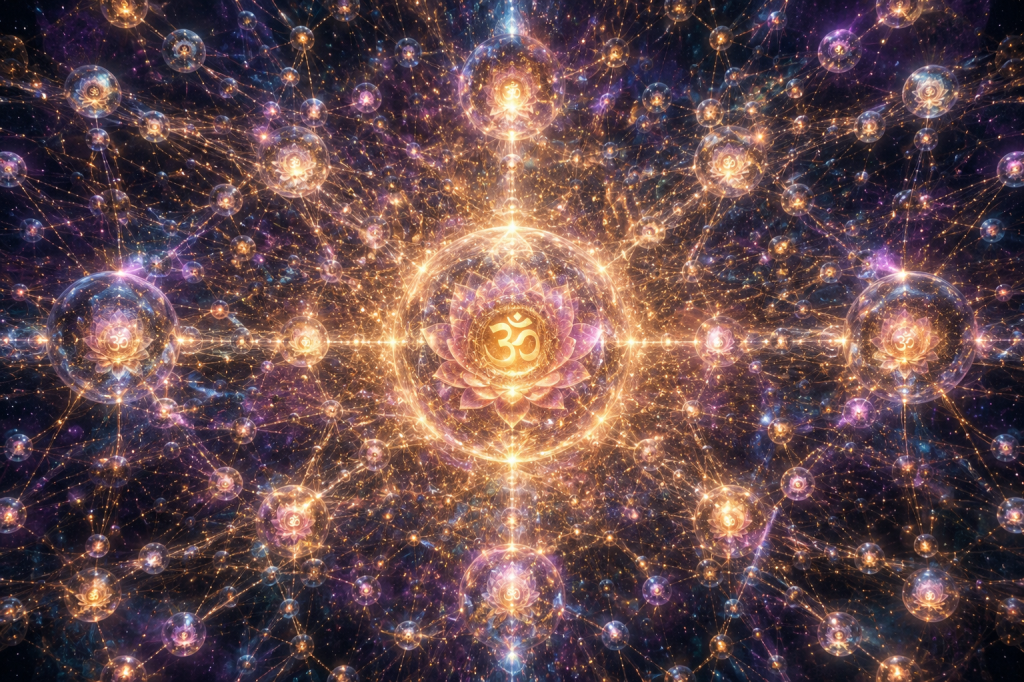
Buddhism teaches what it calls interdependence, the understanding that nothing exists on its own terms. Every thing arises in dependence on conditions, and those conditions arise in dependence on further conditions, without end. The ancient image used to convey this is Indra’s net: an infinite web in which every intersection holds a jewel, and every jewel perfectly reflects every other jewel in the entire web. Nothing stands alone. Everything is, in some sense, everything else. The contemporary Buddhist teacher Thich Nhat Hanh gave this idea a beautiful name: interbeing. Look deeply into a flower, he would say, and you find the cloud that brought the rain, the soil built from generations of fallen leaves, the sun that drove the whole process. The flower does not exist apart from any of this. It is all of this, gathered into a temporary, radiant form.
Kashmir Shaivism, a philosophical and spiritual tradition that emerged in northern India over a thousand years ago, holds a vision of reality that is strikingly parallel. The universe, in this view, is not a population of separate objects. It is one undivided awareness knowing itself through an infinite play of apparent differentiation. What looks like multiplicity, like a world full of distinct and separate things, is the one reality exploring itself through relationship, through contrast, through the dynamic interplay of its own nature. Everything that exists is a relational event arising within and as consciousness itself.
And the Christian mystical tradition, at its most philosophically deep, reaches a structurally similar place from within its own understanding. The doctrine of the Trinity, read not as a theological puzzle but as a statement about the nature of ultimate reality, proposes that the ground of all being is not a solitary, self-enclosed absolute but an irreducible relationship. The persons of the Trinity are not separate beings who happen to be connected. They are constituted by their relationship to one another. At the very root of existence, in this vision, is not a thing but a communion.
Three traditions. Arising on different continents, in different centuries, through entirely different practices and languages. Arriving at the same essential recognition.
And now physics, coming from the opposite direction entirely, using mathematics and experiment rather than meditation and contemplation, is finding its way to the same place.
This is the convergence worth paying attention to.
Not science reluctantly making room for spirituality. Not spirituality borrowing credibility from science. Something more interesting than either of those: two of humanity’s most serious attempts to understand reality, discovering that they have been mapping the same territory from different sides.
Both are finding that the universe is not made of isolated, self-sufficient things. It is made of relationships. Of patterns held in relation. Of coherence sustained across boundaries. Of mutual arising.
Nothing exists in a vacuum. Not particles. Not people. Not, perhaps, consciousness itself.
If that is true, then the idea of a single final equation that captures everything starts to feel not just ambitious but slightly misaligned with what reality actually seems to be. We may be in the early stages of grasping what kind of question physics is really asking. We keep expecting the inquiry to close. Reality keeps opening.
There is a line from the ancient book of Daniel, written centuries before any of this: many shall run to and fro, and knowledge shall increase. Movement, discovery, accumulation. But knowledge increasing is not the same as understanding completing. The verse does not promise arrival. It describes a journey that keeps extending. Every answer opens a corridor of new questions. The running continues.
The Sufi poet Rumi put the same recognition differently, and more provocatively: sell your cleverness and buy bewilderment. At first that sounds like an instruction to stop thinking. It is not. Rumi was one of the most penetrating minds of the medieval world. What he meant was that cleverness, the accumulation of concepts and categories and confident explanations, eventually reaches a threshold beyond which it cannot carry you. Bewilderment, in the Sufi understanding, is not confusion or defeat. It is the sacred opening that appears when the mind has honestly exhausted its frameworks and become available to something larger. It is what genuine inquiry feels like when it is working properly.
And from the ancient Indian Upanishads, composed thousands of years before modern science existed, comes perhaps the most precise formulation of all: the eye cannot see it, the mind cannot grasp it. It is not known by the learned but by those who have learned to unknow. This is not anti-intellectual. It is pointing at something the greatest intellects in every tradition have eventually encountered: that reality at its deepest level is not an object the mind can pin down and possess. It can only be approached by a mind that has become, in some sense, open rather than grasping. Porous rather than defended.
Three voices. Three traditions. Three continents. Thousands of years between them. And all three are pointing at the same thing: that the increase of knowledge, genuinely pursued without the need for premature closure, does not lead to a final answer so much as a deepening capacity for the question. That what lies at the root of reality exceeds every category we bring to it, and that this is not a frustration to be overcome but an invitation to be accepted.
Physics, it turns out, is beginning to learn what the contemplatives always knew. The deeper you go, the more open it gets.
The people and organisations already building this bridge
This convergence is not a fringe idea or a wishful hope. It is happening in funded research centres, published academic work, and the serious thinking of scientists and philosophers who have decided that the boundary between empirical and contemplative inquiry deserves to be questioned rather than policed.
The Mind and Life Institute grew out of a remarkable friendship between the Dalai Lama and the Chilean neuroscientist Francisco Varela. Both believed that science and contemplative practice were asking related questions and that they should be in conversation. The institute now brings together physicists, neuroscientists, psychologists, philosophers, and meditation practitioners for collaborative research that takes both ways of knowing seriously.
The John Templeton Foundation funds academic research at the intersection of science, philosophy, and meaning at a scale few other organisations can match, supporting work on consciousness, cosmology, the nature of time, and human flourishing across universities worldwide.
The Centre for Consciousness Science at the University of Sussex, led by neuroscientist Anil Seth, does rigorous scientific work on the nature of conscious experience, asking what it means for a brain to generate a sense of self and a felt world, questions that sit directly at the meeting point of science and the deepest contemplative inquiry.
The Fetzer Institute works on what it calls the inner dimensions of human life, exploring how science, spirituality, and a commitment to human wellbeing can inform each other, with a network reaching across many countries.
The Institute of Noetic Sciences has a founding story that is itself quietly extraordinary. Edgar Mitchell was an astronaut on the Apollo 14 mission, one of only a handful of human beings to have walked on the moon. On the return journey to Earth, looking out at the stars, he experienced what he could only describe as a sudden overwhelming sense of universal interconnectedness, a direct perception that everything was related to everything else at the most fundamental level. He spent the rest of his life trying to understand that experience rigorously and scientifically. The institute he founded continues that work.
Among individual thinkers doing serious work in this space:
Fritjof Capra, a physicist, wrote The Tao of Physics in the 1970s, one of the first serious attempts to map the structural parallels between modern physics and the contemplative traditions of Asia. It remains a landmark.
David Bohm, one of the most original physicists of the twentieth century, proposed that the apparent separateness of things is a kind of surface phenomenon. Beneath it, he suggested, lies what he called the implicate order, a deeper level of reality in which nothing is truly divided from anything else. His long series of conversations with the philosopher Krishnamurti are among the most remarkable dialogues of the last hundred years.
Karen Barad, who trained as a theoretical physicist before becoming a philosopher, argues that relationships are more fundamental than the things that appear to enter into them. The universe, in her framework, is not made of objects that interact. It is made of interactions from which objects temporarily and provisionally emerge.
Bernardo Kastrup, philosopher and computer scientist, is making a carefully argued case that consciousness is the ground of reality rather than something produced by it, that matter is what consciousness looks like from the outside, and that this position is not only spiritually resonant but philosophically defensible by rigorous standards.
Thomas Metzinger, philosopher of mind at the University of Mainz, treats the findings of neuroscience and the findings of contemplative practice as equally serious evidence about the nature of experience and selfhood.
Carlo Rovelli, whose relational quantum mechanics has already been described, represents perhaps the clearest example of a working physicist whose technical conclusions converge naturally with what contemplative traditions have long understood about the relational nature of existence.
Rupert Sheldrake, biologist and one of the more courageously unconventional thinkers in this field, has spent decades asking whether nature operates according to fixed eternal laws or whether it exhibits something more like memory, whether the universe learns and adapts rather than simply executing a predetermined programme.
The inquiry is real. The people pursuing it are serious. And perhaps the most honest place to end is not with a neat conclusion but with an open door.
We may not be a single equation away from a complete account of reality.
We may be at the beginning of understanding what kind of reality we are actually living in.
And that is not a failure of knowledge.
That is knowledge doing what it does best.
Opening.



Leave a Reply