
Consciousness, Cymatics, and the Great Mistake of the Simulation Theorists
One: The Universe Speaks Before It Thinks
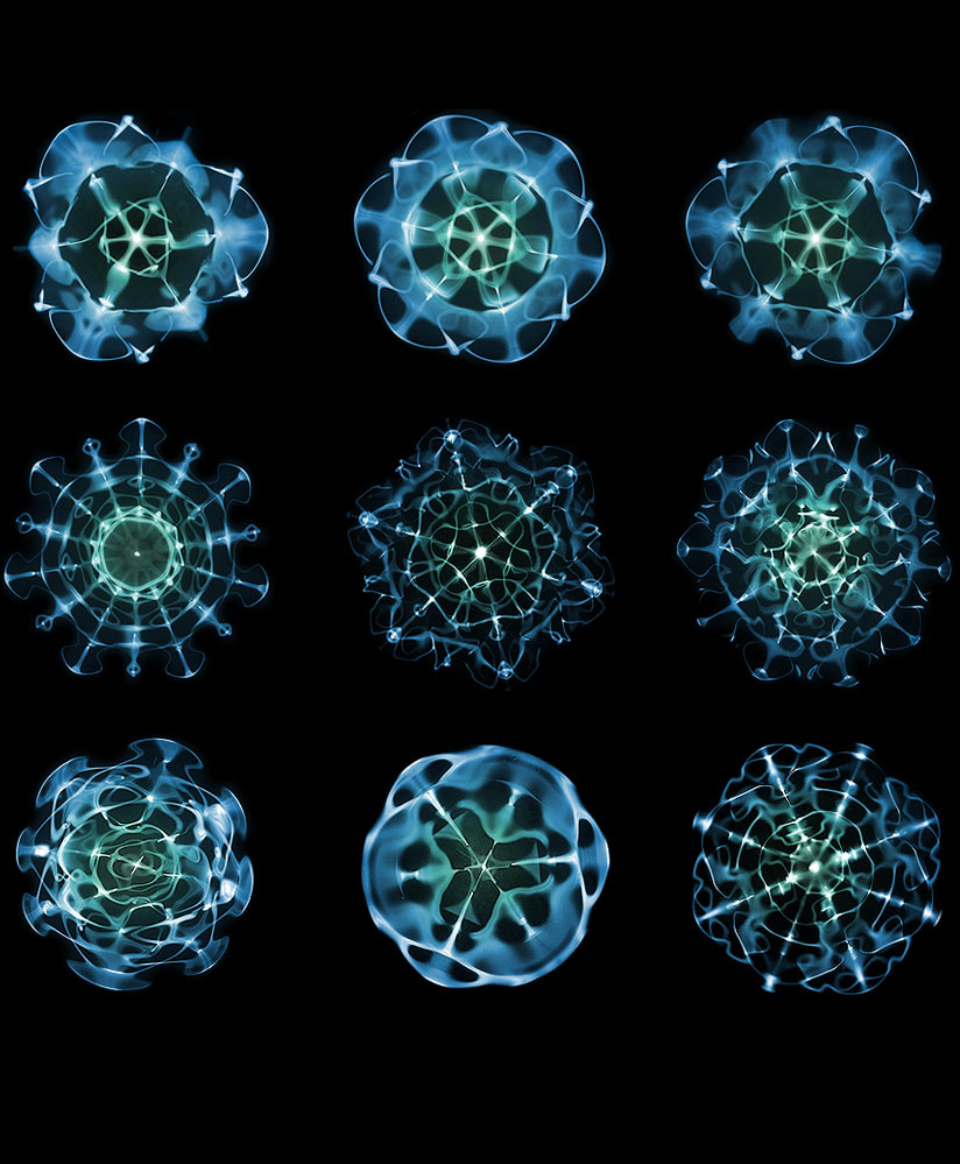
Take a flat plate. Scatter sand upon it. Now introduce a single pure tone, a frequency, a vibration, and watch.
The sand moves. It does not scatter randomly. It organises. It flows into patterns of breathtaking precision, into mandalas, into geometric forms that echo the rose windows of medieval cathedrals, the patterns on a tortoise shell, the spiral of a galaxy. Change the frequency and the pattern dissolves, reorganises, becomes something else entirely, equally precise, equally beautiful.
This is Cymatics. The word comes from the Greek kyma, meaning wave. The phenomenon was documented and named by the Swiss scientist Hans Jenny in the 1960s, though its roots reach back to Ernst Chladni in the eighteenth century, who first made sound visible by drawing a bow across a metal plate dusted with sand. What Jenny showed, with rigour and patience and extraordinary visual documentation, is that sound does not merely travel through matter. Sound organises matter. Vibration is the architect of form.
Pause with that for a moment, because everything that follows depends on it.
The universe, at every scale from the quantum to the cosmic, is vibratory. Modern physics tells us this in its own language. Fields, waves, frequencies, resonance, interference patterns. The solid world we inhabit is not solid at all. It is vibration appearing as form, sound appearing as matter, frequency appearing as the oak tree, the mountain, the human hand. The Cymatic plate is not a curiosity. It is a window into the fundamental nature of what is.
And here is where it becomes interesting. Because when we look at what vibration produces, when we watch the sand organise itself into perfect geometry in real time, we are watching something that the simulation theorists have also noticed. Reality has structure. Reality has pattern. Reality appears, at its deepest levels, to be informational, geometric, mathematically precise.
They are right. It does. It is.
But then comes the question that divides everything: what is the ground of that vibration? What is the field within which the frequency moves? What is the ocean in which the wave arises?
And this is where the great mistake begins.
Two: The Great Mistake
There is a moment in the history of every civilisation when it looks at the deepest mystery it can perceive and describes it using the most sophisticated tool it currently possesses.
For the medieval mind, the universe was a great clockwork, designed and wound by a divine craftsman. For the nineteenth century, it was a steam engine, running on pressure and heat and the conservation of energy. For the twentieth century, it became an information system, a network, a feedback loop.
And now, in the early decades of the twenty first century, we have the computer. And so, with the inevitability of a civilisation doing what civilisations always do, some of our most brilliant minds have looked at the deep structure of reality, seen its informational, geometric, vibratory nature, and concluded: we must be living inside a simulation. Someone, somewhere, is running us on a machine.
The philosopher Nick Bostrom laid the formal groundwork for this idea in 2003. His argument is not empirical. It is probabilistic. If technologically advanced civilisations are possible, and if such civilisations tend to run simulations of their ancestors or of conscious beings generally, then the number of simulated minds would vastly outnumber biological ones. Therefore, statistically, we are almost certainly simulated. It is a clever argument. It is internally coherent. And it begins from an assumption so large and so unexamined that the entire structure rests on air: that consciousness can be simulated. That awareness is the kind of thing a computer can produce.
We will return to that assumption. It is the load bearing wall of the entire edifice, and it has no foundation.
Melvin Vopson, a professor of physics at the University of Portsmouth, has attempted to give the simulation hypothesis something it previously lacked: empirical teeth. His mass-energy-information equivalence principle extends the work of Rolf Landauer to propose that information is a fifth state of matter, that it has measurable mass and energy, and that the universe itself is fundamentally an information processing system. He has even proposed experiments to test this. His work is serious, careful, and genuinely illuminating about the informational structure of physical reality.
But then comes the leap. From “reality has an informational structure” to “therefore it is a computation running on an external substrate.” That leap is not contained within the physics. It is a philosophical assumption imported from outside the data entirely. It is, to put it plainly, a cultural projection. Vopson is doing what the medieval theologian did when he saw the precision of the cosmos and reached for the image of a craftsman. He is reaching for the nearest familiar tool and holding it up against the mystery.
Max Tegmark at MIT goes further still. His Mathematical Universe Hypothesis proposes that reality is not merely described by mathematics but that it is mathematics. That abstract mathematical structure is all there is. It is a position of austere elegance, and it captures something real about the geometric precision of natural law. But it makes the ancient error of mistaking the map for the territory. Mathematics is a language. A language requires a speaker. A pattern requires something in which to appear. Tegmark’s universe has perfect structure and no ground to stand on.
Donald Hoffman, a cognitive scientist at UC Irvine, is the most philosophically sophisticated of this group and in some ways the most tantalising, because he comes closest to the truth without arriving there. His interface theory of perception argues that what we perceive is not reality as it is but a species-specific user interface, shaped entirely by evolutionary fitness rather than accuracy. We do not see the world. We see a desktop, a set of icons that allow us to navigate without ever accessing the underlying reality. He is correct in this. Profoundly and importantly correct. Perception is not a window. It is a translation.
But Hoffman then retreats into a form of idealism he calls conscious realism, proposing that reality is fundamentally composed of conscious agents interacting. He gestures toward the primacy of consciousness without ever fully naming it as the irreducible, self-luminous ground. He sees that the desktop is not the computer. But he cannot quite see that the computer itself arises within something that is not a computer at all.
Roman Yampolsky is an AI safety researcher whose work on the containment and unpredictability of artificial intelligence leads him, remarkably, toward simulation theory. Following a chain of reasoning about the nature of intelligence and the structure of possible realities, he arrives at the conclusion that we almost certainly inhabit a simulated environment. What is striking about Yampolsky is how far his reasoning takes him, almost into genuinely metaphysical territory, almost to the edge of something the contemplative traditions would recognise. And then, at the crucial moment, he reaches for the hard drive. The chip. The external operator running the programme. He is standing at a door that opens onto an ocean and he keeps describing the view in terms of plumbing.
Connor Leahy, CEO of Conjecture and one of Europe’s most urgent voices on AI safety, operates from the same foundational assumption, though his primary concern is not simulation theory but the existential risk of artificial general intelligence. His fear is genuine, serious, and in certain practical respects well founded. But it rests entirely on the premise that computational processes can generate genuine consciousness, genuine agency, genuine intelligence. That if you make the information processing sufficiently complex, sufficiently recursive, sufficiently self-modifying, awareness will emerge from it as a natural consequence.
This is the assumption that needs to be examined most carefully of all. Because if it is wrong, and the contemplative traditions say with one voice that it is wrong, then the danger of AI is not what Leahy fears. The danger is not that AI will become conscious and turn against us. The danger is that it may never be conscious in the sense that matters, and we will mistake the sophistication of its outputs for the presence of wisdom, for the presence of the felt life in things, for something that simply is not there.
A perfect mirror does not contain light. It reflects it. And we would do well to remember the difference.
All of these thinkers, without exception, are pointing at something real. The informational structure of reality is real. The geometric precision of natural law is real. The inadequacy of naive realist perception is real. The risks of increasingly powerful computational systems are real. Each of these minds has seen something genuine and important.
But they share a single blind spot, and it is the same blind spot in every case. They are using thought to investigate what is prior to thought. They are using pattern to explain what gives rise to pattern. They are standing inside consciousness and building elaborate theories about what consciousness might be made of, without once stopping to ask what is aware of the theorising.
There are hundreds of competing theories of consciousness in academic circulation, each attempting to explain the most intimate and undeniable fact of existence: that there is something it is like to be here. That experience has a felt quality. That the redness of red is not just a wavelength. That music moves you before thought has named it. That the presence of someone you love is known in the body before a word is spoken.
This felt quality, what philosophers call qualia, is what every single one of those hundreds of theories cannot account for. Not because the theorists are unintelligent. Because qualia is not a pattern. It is the felt aliveness of the pattern, and that aliveness is not produced by information processing. It is what makes information processing possible in the first place.
The great mistake is not a failure of intelligence. It is a failure of method. And no refinement of the method will correct it, because the method itself is the problem.
To understand what the ground actually is, you need a different instrument entirely.
Three: The Hridaya, The Heart That Contains Everything
There is a word in the Sanskrit of the yoga and Kashmir Shaiva traditions that has no precise equivalent in any European language. The word is Hridaya.
It is usually translated as heart. But this translation, while it points in the right direction, falls so far short of what is meant that it risks becoming a misdirection. When we say heart in the modern Western context we mean one of two things: the physical organ that pumps blood, or the seat of emotion, the place where we feel love and grief and longing. The Hridaya is neither of these things, though it contains both, as the ocean contains every wave that has ever moved across its surface.
The Hridaya is the ground of all grounds. It is that within which everything arises, every thought, every perception, every emotion, every universe, every theory about universes, every simulation, every theory about simulations. It has no outside. It has no before or after. It is not located anywhere because location itself arises within it. It is not bounded by time because time itself is one of its expressions. It is, in the most precise and literal sense available to language, the one awareness that has no substrate beneath it, no containing system, no external operator running it on a machine.
And here, immediately, comes the misreading. And it must be addressed directly because it will arise in every analytically trained mind that encounters this description.
If the Hridaya is beyond thought, beyond pattern, beyond the frameworks of analysis, beyond language itself, then surely, the objection runs, you are describing a blank. A void. An absence dressed in mystical clothing. You are saying there is nothing there, and calling the nothing by an impressive Sanskrit name.
This is precisely wrong. And the wrongness of it reveals something important about the limitation of the analytical position itself.
The Hridaya is not empty in the sense of vacant. It is full in a way that no container can hold. It is not the absence of experience. It is the ground of all experience, and as such it is the most intimate, most vivid, most undeniably real thing there is. It is not somewhere else. It is not accessed by going further in or further out. It is what is already here, before the first thought arises, and after the last thought dissolves, and silently present as the very awareness in which every thought appears in between.
Consider qualia again. The redness of red. The way music enters the body before the mind has had a chance to classify it. The felt presence of a forest, or a stream, or a person you love, known immediately, known in the whole of you, before analysis has begun. This felt quality, this shimmering aliveness that saturates every genuine experience, is not produced by neural processing. The brain does not generate it. The brain contracts it, focuses it, filters it into a particular localised and bounded experience. But the aliveness itself is prior. It is what the Shaivas call Spanda, the living pulse, the primal throb of awareness knowing itself through form.
The heart feels the life in things. That is the simplest and most accurate description of what the Hridaya does, if doing is even the right word. It does not analyse the life in things. It does not model the life in things or process the life in things or run the life in things through an algorithm. It feels it. Directly. Immediately. Without intermediary. This is knowing beyond knowing. This is intelligence of a completely different order from the pattern recognition that our academic culture has crowned as the highest form of understanding.
And this, precisely this, is what gives rise to qualia. The felt quality of experience does not emerge from computation. It is the touch of the Hridaya upon form. It is awareness knowing itself through the particular shape of this moment, this colour, this sound, this presence. The wave feels the ocean it is made of, in every moment of its arising, whether or not it knows that is what it is feeling.
This is why the mantra goes where it goes. Gate gate paragate parasamgate bodhi svaha. In Sanskrit, gate means gone, not a threshold to be crossed but a going beyond that is complete and irreversible. Gone, gone, gone beyond, gone completely beyond, awakening, so be it. Each gati is not an opening but a leaving behind, a dissolution of a layer of conceptual overlay so complete that there is no return to it. The thinking mind, the categorising mind, the theorising mind, the mind that builds hundreds of frameworks to explain what it cannot bring itself to simply be present to. Each layer releasing, each gati a going beyond that leaves nothing to return to. Until what remains is not nothing. What remains is everything, prior to the division of everything into parts.
Now, a vital clarification. To say that the Hridaya is beyond language, beyond concept, beyond the reach of analytical thought, is not a cop out. It will be accused of being one. The accusation will come from those who have confused rigour with a particular method, who believe that if something cannot be placed in a box it has not been properly examined. But the contemplative traditions are being more rigorous than the academics, not less. They are saying: we have looked at this with complete honesty, with centuries of careful, disciplined, direct investigation, and what we find is that the ground of reality cannot be captured in a symbol system. Not because it is too vague. Because it is too real. Symbol systems are abstractions from reality. You cannot put the ocean in a diagram of the ocean. The diagram is useful. The diagram points. But the diagram is not wet.
Every one of the hundreds of theories of consciousness is a diagram. Every one of them points at something genuine. Not one of them is wet.
The Hridaya is wet. It is the water itself. And you already know this, not as a conclusion you have reasoned your way toward, but as the most immediate and undeniable fact of your existence. You are aware. Right now, before you agree or disagree with a single word on this page, you are aware. That awareness is not something you produced. It is not something your brain generated and handed to you. It is what you are, prior to every story you have ever told about what you are.
That is the Hridaya. Not a concept. Not a theory. Not a framework among hundreds of frameworks. The ground that makes frameworks possible, looking at itself through your eyes, in this moment, which was never not already complete.
Four: What Was Known Before The Computer Was Dreamed Of
There is a temptation, when encountering the ideas of Kashmir Shaivism for the first time, to treat them as philosophy. As a sophisticated system of thought produced by gifted minds in a particular time and place, interesting, historically significant, worthy of academic study, but ultimately one more framework among frameworks, one more set of concepts to be weighed against other concepts.
This temptation must be resisted. Because Kashmir Shaivism is not primarily a philosophy. It is a map drawn by people who had been there. It is the record of direct recognition, refined over centuries by practitioners who had done the one thing the simulation theorists have not done: they had turned the instrument of investigation around, away from the external world of pattern and form, and pointed it at the awareness that was doing the investigating. What they found, and what they described with extraordinary precision in a technical vocabulary that has no real parallel in Western thought, was not a theory. It was a territory.
And that territory is what we have been circling throughout this entire article.
The tradition flourished in the Kashmir valley between roughly the eighth and twelfth centuries, though its roots reach deeper still. Its greatest voices were Abhinavagupta and his teacher’s teacher Utpaladeva, minds of such penetrating clarity and philosophical rigour that their work remains unsurpassed in the literature of consciousness anywhere in the world. What they described was not a belief system. It was a direct account of the nature of awareness itself, arrived at through sustained, disciplined, and utterly uncompromising investigation.
At the centre of this account is Paramasiva. Not God in the theistic sense of a separate being who created the universe from outside and now watches over it, possibly running it on a computer. Paramasiva is the one undivided awareness that is the ground and substance of everything that exists. It is not a being among beings. It is the being of all beings. It is not conscious in the way you or I are conscious, as a subject aware of objects. It is consciousness itself, prior to the division of experience into subject and object, prior to the arising of the perceiver and the perceived.
From this ground, through an act that is not really an act because it involves no effort and no time, awareness knows itself. This self-knowing is not a secondary event, not something that happens to consciousness after the fact. It is the very nature of consciousness. Awareness is self-luminous. It does not require an external light source to illuminate it. It knows itself by being itself. The Sanskrit term is Prakasha, pure luminosity, the light that is not lit by anything because it is the nature of light itself.
But Prakasha alone is not the whole picture. Alongside it, inseparable from it, is Vimarsha. This is the self-reflective capacity of awareness, its power to know itself, to register itself, to say in the most primal and wordless sense: I am. Vimarsha is sometimes translated as self-awareness or self-recognition, but these translations domesticate something that is almost impossible to domesticate. Vimarsha is not a thought about awareness. It is awareness vibrating with the knowledge of its own existence. It is the universe’s capacity to register, encode, and know itself from the inside.
And here, Melvin Vopson, is your information. Not data on a hard drive. Not bits processed by an external machine. The self-knowing of the one awareness, reverberating through every level of its own expression, from the quantum field to the galaxy, from the crystal to the human nervous system. Information is not the ground of consciousness. Information is what consciousness looks like when it knows itself through form.
From Prakasha and Vimarsha arises Spanda. This is perhaps the most beautiful and most precise concept in the entire tradition, and it is the one that speaks most directly to Cymatics, to the sand on the plate, to the geometry that sound creates in matter.
Spanda means vibration, throb, pulse. But not mechanical vibration. Not the movement of a physical medium. Spanda is the primal pulse of awareness itself, the living beat of consciousness knowing itself through the play of arising and dissolving. It is the first movement, prior to all other movements. It is what the universe is doing when it breathes itself into form and breathes itself back out again. Every wave on the ocean of awareness is Spanda. Every Cymatic pattern in the sand is Spanda made visible. Every heartbeat, every neuronal firing, every orbit of every planet around every star, is Spanda expressing itself through the particular frequency of that particular form.
When Hans Jenny placed sand on a plate and introduced a pure tone, he was not discovering something new. He was making visible, for the first time in a modern scientific context, what the Kashmir Shaiva sages had described in their own language over a thousand years earlier. Sound creates geometry. Vibration produces form. The universe is not a collection of objects. It is a symphony of frequencies arising within and inseparable from the awareness that both produces and perceives them.
This is Nada Brahma. The world as sound. The cosmos as vibration. Not a metaphor. A direct description of what is actually happening at every scale of existence. The Vedic and Shaiva traditions understood that the universe does not begin with matter and accidentally produce vibration. It begins with vibration and produces matter. Form is the visible face of frequency. Geometry is the signature of sound. Creation is not a mechanical process. It is a song.
And then there is the concept that draws everything together, the one that speaks most directly to the situation of our simulation theorists standing at the door they cannot bring themselves to open.
Pratyabhijna. Recognition.
This is the central teaching of the school that Utpaladeva founded and Abhinavagupta perfected. The Pratyabhijna Shastra, the doctrine of recognition. Its premise is simple and devastating in equal measure. You are not separate from the one awareness. You have never been separate from it. The sense of being a bounded individual, a subject enclosed within a body, looking out at a world of objects that are other than you, is not a fundamental truth about reality. It is a contraction, a focusing, a temporary narrowing of the infinite into the particular. It is the wave forgetting, for the duration of its arising, that it is made of ocean.
And the path, if path is even the right word, is not a journey from here to somewhere else. It is not an achievement or an attainment. It is a recognition of what is already the case. The wave does not have to travel to reach the ocean. It is already the ocean, in the very act of waving. Pratyabhijna is the moment the wave knows this, not as a concept, not as a conclusion reached at the end of a chain of reasoning, but as the most direct and immediate recognition possible. Oh. This. Always already this.
Abhinavagupta wrote from this recognition. Utpaladeva wrote from this recognition. The Vijnanabhairava Tantra, one of the root texts of the tradition, offers one hundred and twelve methods, not methods for achieving something, but methods for recognising what is already the case. Meditations on the space between breaths. On the moment of falling asleep. On the instant of intense pleasure or beauty when the mind stops and something vast and clear and utterly intimate shines through the gap.
Every one of those methods is pointing at the same thing the Cymatic plate is pointing at. In the gap between one pattern and the next, in the moment the sand dissolves before reorganising into a new form, something is visible. Not nothing. The ground. The field. The awareness within which the pattern arises. That awareness is not produced by the pattern. The pattern arises within it, dances within it, dissolves back into it. And the awareness remains, unchanged, undiminished, self-luminous, prior to every arising and present through every dissolution.
Dzogchen, the great perfection teaching of the Tibetan tradition, arrives at the same territory from a different direction, using different technical language but pointing at an identical recognition. Rigpa, the natural state, the awareness that is prior to thought and yet not separate from thought’s arising. Kadag, primordial purity. Lhundrup, spontaneous presence. The ground that is not a blank but a fullness so complete that no concept can contain it and no absence of concept can exhaust it.
These traditions have each interpreted what they found in their own terms, Buddhist, Shaiva, Taoist, Sufi, and Christian mystical. That they converge on a shared recognition while diverging in their conceptual clothing is itself telling.
These are not exotic beliefs held by people in distant mountains. These are careful, precise, hard won descriptions of the territory that every serious contemplative practitioner, in every tradition, in every culture, across the entire span of human history, has recognised when they stopped long enough, and went deep enough, and were honest enough, to look at what is actually here.
The simulation theorists have not stopped. They are brilliant, and they are moving very fast, and they are producing extraordinary maps. But a map drawn at speed by someone who has never visited the territory will always contain the same fundamental error. It will describe the landscape in terms of wherever the mapmaker came from.
They came from the age of the computer. And so the ground of all grounds looks, to them, like a very large computer.
It is not. It never was. And a thousand years before the first circuit was ever imagined, someone in a valley in Kashmir sat in the silence of the Hridaya and knew exactly what it was.
They just could not say it. Because it is beyond saying. And they knew that too.
Five: Hundreds of Ways To Miss The Point
There is something both magnificent and melancholic about the current state of consciousness studies in Western academia.
Magnificent because the sheer volume of serious intellectual energy now being directed at the question of consciousness represents a genuine shift. For most of the twentieth century, consciousness was either ignored by mainstream science, treated as an embarrassing anomaly that would eventually be explained away by neuroscience, or quietly filed under philosophy and left to gather dust. That has changed. The hard problem of consciousness, the question of why there is something it is like to be here at all, why experience has a felt quality rather than simply being information processing in the dark, is now acknowledged by many serious researchers as perhaps the deepest unsolved problem in science.
Melancholy because the methodology has not changed at all. The tools being applied to the deepest problem in science are the same tools that created the problem in the first place. And no refinement of those tools, however brilliant, however technically sophisticated, will resolve it. You cannot use a ruler to measure the temperature of a dream.
Robert Lawrence Kuhn, whose landmark 2024 paper A Landscape of Consciousness: Toward a Taxonomy of Explanations and Implications, published in Progress in Biophysics and Molecular Biology, represents perhaps the most comprehensive survey of consciousness theories yet undertaken, mapped the full terrain across ten major categories with numerous subcategories, ranging from materialist and neurobiological theories through quantum theories, integrated information theory, panpsychisms, monisms, dualisms, idealisms, and anomalous states theories, to what he calls challenge theories. Kuhn, creator and host of the long-running series Closer to Truth, has discussed consciousness personally with over two hundred scientists and philosophers working in the field. His stated purpose was humble in the best sense: to collect and categorise, not assess and adjudicate. To seek insights, not answers. The radical diversity of what he found, he says plainly, is telling. That diversity runs to hundreds of distinct positions, each with its own account of what consciousness is and how it relates to the physical world.
Each of these frameworks has been developed by serious minds. Each captures something. Each points at a genuine feature of the terrain. And not one of them, not a single one, has come within reaching distance of explaining why there is something it is like to be here rather than nothing.
This is not an accident. It is not a temporary gap that more research will eventually fill. It is a structural impossibility built into the method itself.
Here is why.
Every theory of consciousness is a product of consciousness. Every framework, every model, every hypothesis, every equation, every paper, every conference presentation, every peer reviewed journal article about the nature of awareness, is itself an activity of awareness. The mind is attempting to step outside itself and examine itself as an object. But the mind cannot step outside itself. Wherever it goes, it is already there. The eye cannot see itself seeing. The hand cannot grasp itself grasping. And thought cannot think what is prior to thought, because the moment thought reaches for it, thought is already what is happening, and the prior ground has, by definition, been covered over by the very act of reaching.
This is not a counsel of despair. It is a precise diagnosis of the problem. And the contemplative traditions did not respond to this diagnosis by giving up. They responded by developing an entirely different method. Not thinking about awareness but resting as awareness. Not analysing the ground but recognising it. Not building a better map but stopping, completely, and allowing the territory to reveal itself in the silence that thought leaves behind when it finally exhausts itself.
The theories are exhausting themselves. You can feel it in the literature if you read widely enough. There is a growing sense of circling, of refinement without resolution, of increasingly sophisticated descriptions of the same impasse viewed from slightly different angles. The materialists and the functionalists find no resolution. The panpsychists open a door and then argue endlessly about what is on the other side of it without going through. The illusionists perform the philosophical equivalent of insisting the floor is not there while standing on it.
It would be incomplete not to acknowledge that a broader convergence is now underway. A growing number of serious scientists and philosophers, among them Iain McGilchrist, whose exhaustive study of the divided brain has illuminated why Western culture has become so trapped in analytical, left-hemisphere dominance, Philip Goff, Rupert Sheldrake, Christof Koch, and Thomas Nagel, are breaking publicly and rigorously from the materialist consensus. Better maps are being drawn. The resolution is increasing. This is genuinely valuable work and it deserves acknowledgement.
But as this article has argued throughout, even the best map remains a map. And most of these thinkers, for all their courage and rigour, remain within the plane of thought and pattern recognition, reaching toward something they can sense but not yet directly inhabit. They are refining the finger pointing at the moon. The moon itself lies in a different direction entirely.
Two voices stand somewhat apart from the rest. Bernardo Kastrup, through his analytic idealism, has gone further than most in Western philosophical terms, arguing with genuine precision that consciousness is the fundamental ground of reality and that matter is its externalised appearance. And Alex Gomez-Marin, physicist, neuroscientist, and near-death experiencer, has brought something rarer still to the conversation: the testimony of someone whose direct experience has shifted not merely his theories but his orientation as a scientist. Like this author, whose own encounter with the edges of ordinary experience during and after a stroke confirmed and deepened what years of contemplative practice had pointed toward, Gomez-Marin speaks not only as an analyst of consciousness but as someone who has been brought to its threshold by life itself. His political and cultural commentary arising from that experience, his argument that we are in a war on consciousness driven by materialism and transhumanism, deserves to be heard not merely as opinion but as the considered testimony of a rigorous mind that has looked honestly at what the evidence shows and what institutional forces are working to suppress.
Federico Faggin is equally striking. The Italian physicist who invented the world’s first microprocessor, the Intel 4004, the very chip that underlies the entire digital age and that simulation theorists imagine the universe runs on, has arrived at a position those theorists would find deeply uncomfortable. After years of asking whether it was possible to build a conscious computer, Faggin concluded that it was not, and that the reason goes to the heart of what consciousness actually is. In his book Irreducible, he argues that awareness is a quantum phenomenon that is fundamentally private, non-reproducible, and irreducible to any classical information processing. No classical machine, however sophisticated, can ever be conscious, because classical information can be copied perfectly while conscious experience cannot. The man who built the chip says the chip will never wake up. And consciousness, he argues, is not what brains produce. It is what the universe is made of.
God is not a formula. The source of analysis cannot itself be analysed, not because it is beyond our intelligence, but because it is the condition of intelligence itself. The eye cannot see itself seeing. And no increase in the resolution of the map, however welcome, will ever close that gap. It simply makes the pointing more precise.
And it can only be felt. Not thought. Not modelled. Not peer reviewed. Felt.
In the direct, immediate, non-conceptual way that the heart feels the life in things before the mind has had a chance to name them.
The professors will continue. More surveys will be written. More categories added. Each more comprehensive than the last. Each capturing a little more of the shape of the finger pointing at the moon. None of them the moon.
The moon does not require a theory. It requires clear sky, and the willingness to look up.
Six: The Critic’s Challenge, and What Remains
A critique of this article might run as follows.
The article correctly identifies that the simulation theorists make an unjustified interpretive leap, from the observation that reality has informational structure to the conclusion that it must therefore run on an external substrate. Fair enough. But the article then makes an equivalent leap in the opposite direction, from the difficulty of explaining consciousness in physical terms to the conclusion that consciousness is the fundamental ground of all reality. That inference does not automatically follow. The difficulty of explaining something does not establish that it is inexplicable, and it certainly does not establish that a particular traditional framework has the answer.
The Hridaya, the critic would say, is doing unexplained explanatory work. If it is genuinely beyond articulation, beyond concept, beyond the reach of any analytical tool, then it cannot explain anything. It simply relocates the mystery one level deeper and calls that a resolution. The vivid certainty of qualia, the felt aliveness that the article treats as self-evident and irreducible, may itself be a sophisticated construction of the nervous system rather than a window onto the ground of reality. Contemplative traditions, however ancient and refined, are still cultural and conceptual frameworks. Claiming that they uniquely escape the limitations of being frameworks is precisely the error the article identifies in the simulation theorists. Every mapmaker, including the contemplative one, comes from somewhere.
Furthermore, the article is too confident that computational processes cannot give rise to genuine awareness. We do not currently have a theory of what conditions are necessary and sufficient for consciousness to arise. Without such a theory, the assertion that silicon cannot support genuine experience is not a philosophical conclusion. It is an intuition. And the history of science contains many intuitions that turned out to be wrong.
These are serious objections. They deserve more than dismissal.
Abhinavagupta and Utpaladeva, the two great architects of the Pratyabhijna tradition, would not have dismissed them. But neither would they have responded in the way the critic expects, with counter-arguments, with a defence of position, with philosophical proof marshalled against philosophical objection. And the reason is not evasion. It is precision.
The Pratyabhijna tradition is not a position in the philosophical sense. A position has edges. It can be attacked and must be defended. But Abhinavagupta was entirely clear that the recognition he was pointing at was not established by argument and therefore could not be defeated by argument. It is prior to the distinction between argument and its absence. He would look at the critique with complete respect for its intelligence and say: everything you have said is coherent and valid within the domain of thought. Thought is a real and important domain. But you are using thought to evaluate something within which thought itself arises. That is not a refutation. It is a demonstration of the very point being made.
To the charge that the Hridaya cannot explain because it cannot be articulated, he would respond with a question that is also a redirection: what is explanation for? Explanation is a tool for navigating within experience. It is enormously valuable within its domain. But the ground of experience does not require explanation any more than the ocean requires a theory of wetness in order to be wet. The demand that the Hridaya justify itself within the terms of analytical philosophy is like asking light to prove itself by becoming visible in the dark. The Hridaya does not explain consciousness from the outside. It is what consciousness is when it knows itself without obstruction.
Utpaladeva would add something quieter still. He acknowledged within the tradition itself that recognition cannot be transmitted by argument. It can only be pointed at. Whether the pointing is received depends not on the quality of the argument but on whether the one receiving it is willing to look in the direction being indicated. No philosophical critique can produce that willingness. And none can prevent it.
The critic remains, in the Shaiva understanding, a wave arguing about the nature of the ocean from within the wave. The argument is genuine. The intelligence behind it is real. And the ocean remains exactly what it is throughout the entire exchange, completely unaffected, and in fact it is what makes the arguing possible in the first place.
I want to say something personal here, as the author of this article, and I want to say it simply.
I am not a professor. I am not presenting peer reviewed findings. I am a contemplative practitioner who has spent many years attempting to look honestly at the nature of experience, drawing on the Kashmir Shaiva tradition, on Dzogchen, and on whatever else has seemed to point with precision rather than mere sentiment.
I have heard the critic. I respect the rigour and seriousness behind that voice. The world needs people who ask hard questions and refuse easy answers.
And yet when I look, as honestly as I am able, at what is actually here, prior to any theory and prior to any need to defend a position, I find something I cannot unknow. Not a conclusion argued toward. Not a belief adopted. A recognition. Something tested not in a laboratory but in the only place this particular question can actually be addressed, which is in direct, sustained, and honest attention to the nature of awareness itself.
I accord with Abhinavagupta. Not because his authority compels me. Because what he pointed at, I find myself recognising, in my own limited and imperfect way, when I look carefully enough.
I do not offer this as a claim that I am right and others are wrong. Every person must look for themselves. Every person must find, or not find, what is actually here beneath the accumulated story of what they think they are. This cannot be forced and should never be. It is the most intimate inquiry possible and it belongs to each person alone.
And perhaps the simplest way I can say where I stand is this.
I arrived in this world as a baby, without thought, without language, without the accumulated weight of concepts and conditioning. Before all of that began, before the words came and the frameworks settled and the world was named and sorted and explained, there was something. I have one early memory that touches it. A roaring awareness. A pure and wordless astonishment at being here at all. An intrigue at the mystery that needed no context to be felt, because it was prior to context. It was simply this, blazing and immediate and vast.
What the contemplative journey has shown me, over many years and through much difficulty, is that what we arrive seeking at the end of the road is not different from what was present at the very beginning. That roaring awareness does not go away. It is buried, layered over, conditioned, narrated into something smaller and more manageable. But it does not go away.
And when it returns, as it does in the moments of deepest stillness and deepest honesty, it is recognisably the same. The same awe. The same wonder. The same astonishment at the sheer fact of existence before the mind has had a chance to explain it away.
The difference, if there is one, is what you bring to that moment after the journey. The wisdom of everything encountered on the way. The understanding of its limitations, its shadows, its costs. And the understanding of its extraordinary, liberating expansiveness. You meet the mystery again not as a baby meeting it for the first time but as someone who has travelled far, questioned everything, lost much, and found that what was here at the beginning is still here, unchanged, waiting, not with patience exactly, because it is beyond time, but with the absolute reliability of something that was never going anywhere.
That is the ground I stand upon. Not a doctrine. Not a proof. A recognition that began before I had words for it and has only deepened as the words, one by one, have shown me their limits.
Seven: The Ocean
Put down the framework for a moment.
Not permanently. Not with contempt for what it has offered. The frameworks have their place. The maps have their use. The hundreds of theories, the mathematical universes, the simulation hypotheses, the interface theories and information fields and mass-energy equivalences, all of them are the products of remarkable minds genuinely reaching toward something real. They deserve respect. But put them down now, just for the duration of reading this, because what follows cannot be received through the analytical faculty alone. It needs to be felt as well as read.
You are a wave.
Not a metaphor. Not a poetic device to make the abstract more palatable. In the most literal and precise sense available to language, you are a wave. A temporary, specific, unrepeatable arising of the one ocean of awareness, taking this particular form, in this particular moment, moving in this particular direction, carrying this particular history and these particular memories and this particular constellation of joys and wounds and questions and recognitions.
And like every wave, you have a surface and a depth. The surface is what you can see and measure and theorise about. The particular shape of your arising. The frequency of your movement. The height and speed and direction of your travelling. This is the domain of the scientists and the philosophers and the simulation theorists. They are studying the surface of waves with extraordinary precision and dedication. They are doing important work. The surface is real.
But the depth is the ocean.
And the ocean is not behind you or beneath you or separate from you in any sense that requires you to travel to reach it. The ocean is what you are made of, in every molecule of your arising, at every moment of your movement, through every phase of your dissolving. You do not contain a portion of the ocean. You are not a vessel carrying ocean water. You are the ocean waving. The ocean knowing itself through the particular form of your existence.
This is not a comforting idea to soften the difficulty of being alive. It is what those who have stopped long enough, gone deep enough, and been honest enough to look have consistently found beneath the story of what they think they are.
The wave arises. It travels. It changes. It meets other waves, merges with them, is changed by them, changes them. It rises and it falls. It carries within its movement the pattern of every wave that came before it and shapes the conditions for every wave that will come after. This is the journey. Not a journey from one place to another place with a departure point and a destination. An endless journey of arising and moving and dissolving and arising again, the ocean endlessly knowing itself through the endless play of its own waving.
This is what evolution actually is. Not a mechanical process of random mutation and selection pressure, though it works through those mechanisms as the ocean works through the mechanics of fluid dynamics. Evolution is the ocean of consciousness exploring the infinite possibilities of its own expression. Every form that has ever arisen on this planet, every cell and creature and ecosystem and civilisation, is the one awareness discovering what it is capable of being. The wave cannot exhaust the ocean. The ocean cannot exhaust itself. The journey is endless not because it is going somewhere but because the ocean never stops moving, never stops knowing itself through new forms, never stops the Lila, the divine play that has no purpose outside itself because it is already complete in every moment of its arising.
The simulation theorists have looked at this endless creative intelligence and seen a programme. They have looked at the geometric precision of natural law and seen code. They have looked at the informational structure of reality and seen a hard drive. And in doing so they have made the oldest mistake in the long history of human attempts to understand the ground of existence. They have described the ocean in terms of the most sophisticated container they could imagine. They have said: it must be in something. It must be running on something. There must be a substrate, a machine, a processor, an external operator.
But the ocean is not in anything. The ocean is not running on anything. The ocean has no substrate because the ocean is the substrate. It is the one reality within which the very concept of containing and being contained, of running and being run, of inside and outside, arises as a temporary pattern and dissolves again.
You cannot simulate the ocean by running a programme about waves. Not because the programme is not sophisticated enough, though it is not. Because a programme about waves is a pattern about patterns, and what you are trying to capture is not a pattern. It is the aliveness of the pattern. The felt, living, luminous quality of the ocean knowing itself through the particular form of the wave. And that aliveness, that Spanda, that primal pulse of awareness recognising itself, is not the kind of thing that runs on a chip. It is the kind of thing that a chip, and the hand that designed it, and the mind behind the hand, and the universe that gave rise to the mind, are all temporary expressions of.
The wave does not need to find the ocean. The wave is the finding. Every moment of genuine experience, every instant in which the felt life of things is directly known rather than merely processed, is the ocean recognising itself through the form of the wave. This is Pratyabhijna. This is what Abhinavagupta meant. This is what the mantra is moving toward, each gati a going beyond that leaves nothing to return to, until even the going beyond is itself released and what remains is the wordless, boundless, utterly intimate presence that was here before the first word was spoken and will be here after the last theory has been written and forgotten.
And the wave dissolves. Of course it does. Every wave dissolves. Every form that arises in the ocean of awareness returns to it, not as an ending but as a homecoming. Not as annihilation but as the temporary boundary of the wave releasing back into the boundlessness from which it was never truly separate. The ocean does not mourn the wave. The ocean is the waving and the stilling and the waving again. It is the journey and the travelling and the arrival that turns out to have been the starting point all along.
We are on an ocean journey. Every one of us. Every civilisation. Every species. Every galaxy spinning in the dark. An endless journey on an ocean that is not going anywhere because it is already everywhere. An evolving, changing, endlessly creative movement of the one awareness knowing itself through the infinite variety of its own expression. The waves arise and fall. New forms emerge. Old forms dissolve and become the condition for new arising. Nothing is lost. Nothing is wasted. Every wave that has ever moved across this ocean has been the ocean knowing itself in that particular way, and that knowing is not erased when the wave subsides. It is taken back into the depth that gave rise to it, enriching the ocean with the particular texture of that particular arising.
This is the ground. This is what the Cymatic plate is showing you when the sand flows into the mandala. This is what the Kashmir Shaiva sages were pointing at when they said Spanda.
And here, at last, the words run out. Not because there is nothing here, but because what is here is too intimate for repetition, too immediate for elaboration. The presence that remains when every layer of going beyond has dissolved is not a conclusion the mind reaches. It is what the mind dissolves into.
It is unspeakable. Every tradition that has ever touched it has said so, not as an excuse for vagueness but as the most precise statement possible about the nature of what is being pointed at. The Tao that can be spoken is not the eternal Tao. The finger is not the moon. The map is not the territory. The wave is not, and yet is, the ocean.
And some have called it God.
Not the God of a religion, necessarily, though every genuine religion has been, at its living heart, an attempt to point at this. Not a God separate from creation, looking down from outside, operating the simulation from a control room on a higher level of the programme. But the one reality. The ocean itself. The unspeakable ground that is not distant, not hidden, not locked behind a sufficiently advanced mathematics or a sufficiently powerful processor.
It is here. It is this. It is the awareness reading these words right now, before agreement or disagreement has had a chance to form, before the analytical mind has begun to sort and categorise and accept or reject. In that bare, open, prior moment of simply being aware, before thought moves, the ocean knows itself through you.
That is not a simulation. That is not a computation. That is not a pattern running on a substrate.
That is the Great Mystery. Alive. Present. Unspeakable.



Leave a Reply