
When it comes to consciousness, its depth and the architecture of awareness, one of the most overlooked insights is that consciousness does not only manifest forms. It manifests scales of reality.
Ordinarily, we imagine existence as composed of separate things interacting with one another. But Trika philosophy of Kashmir Shaivism suggests something far stranger: what changes is not only the content of experience, but the scale at which consciousness is knowing itself.
A wave on the surface experiences reality differently from the Ocean in its depth, not because they inhabit different universes, but because awareness is operating through different scales of contraction and expansion.
At the narrowest scale, consciousness experiences itself as the individual self, bound to a single body, a single history, a single stream of thought. Time feels linear. Space feels external. Life appears fragmented into separate objects and events.
But as awareness expands, reality reorganises itself. Patterns begin replacing isolated events. Relationships become more fundamental than objects. Synchronicities become intelligible. Intuition deepens. The boundary between inner and outer becomes more permeable. One no longer experiences existence as disconnected pieces, but as movements within a living field.
And beyond even this, Trika points toward a scale of awareness in which the universe is experienced as a single simultaneous act of consciousness, an indivisible unfolding within the Heart of awareness itself.
This is why the tradition places such emphasis on recognition rather than acquisition. Nothing new is added. What changes is the scale at which reality is perceived.
The Ocean metaphor expresses this beautifully.
A small wave experiences only its immediate rise and fall. It interprets the Ocean locally, through the narrow horizon visible from its crest. But the deeper awareness sinks into the Ocean, the more the apparent fragmentation of the surface begins resolving into larger currents, tidal movements and vast interconnected patterns.
Eventually, one realises that what seemed like separate waves were always expressions of one continuous body of water moving at different scales simultaneously.
But here something must be said carefully, something the tradition itself insists upon.
The wave is not a mistake. The individual self is not an error to be corrected or an illusion to be dissolved. It is a particular resolution of the field, the way a high magnification image is not wrong but simply cannot see the larger structure that lower magnification reveals. Both resolutions are real. Both are the Ocean. The contracted scale has its own kind of precision, its own intimacy with the texture of things.
This is what separates the Shaiva understanding most decisively from certain strands of Advaita. The apparent world is not mere superimposition on an otherwise featureless absolute. It is the absolute knowing itself at a particular depth, with a particular quality of attention. Contraction is itself a movement of Shiva, not a fall away from Shiva.
And here Spanda, the doctrine of divine pulsation, enters with a subtlety that deepens the entire picture. If the Ocean descends into depth to know its own vastness, it also needs its surface to know itself in the intimacy of particularity. The pulsation at the crest of the wave is irreplaceable. The Ocean requires its waves to know itself at that precise scale of resolution. The surface sees something the depth cannot, by virtue of its very proximity to the particular.
This means the relationship between scales is not a hierarchy in which the deeper simply supersedes the shallower. It is a living reciprocity. Each scale of awareness offers the whole something the other scales cannot provide. Awakening, in this light, is not the elimination of the particular but its full transparency to the universal, both held simultaneously, neither cancelled by the other.
This reframes awakening entirely. Awakening is not escape from the world. It is movement into greater dimensional intimacy with it.
The wave does not leave the Ocean. It begins perceiving from deeper within it, while remaining fully, irreplaceably a wave.
And this brings us to something the tradition encodes not only in philosophy but in sacred geometry.
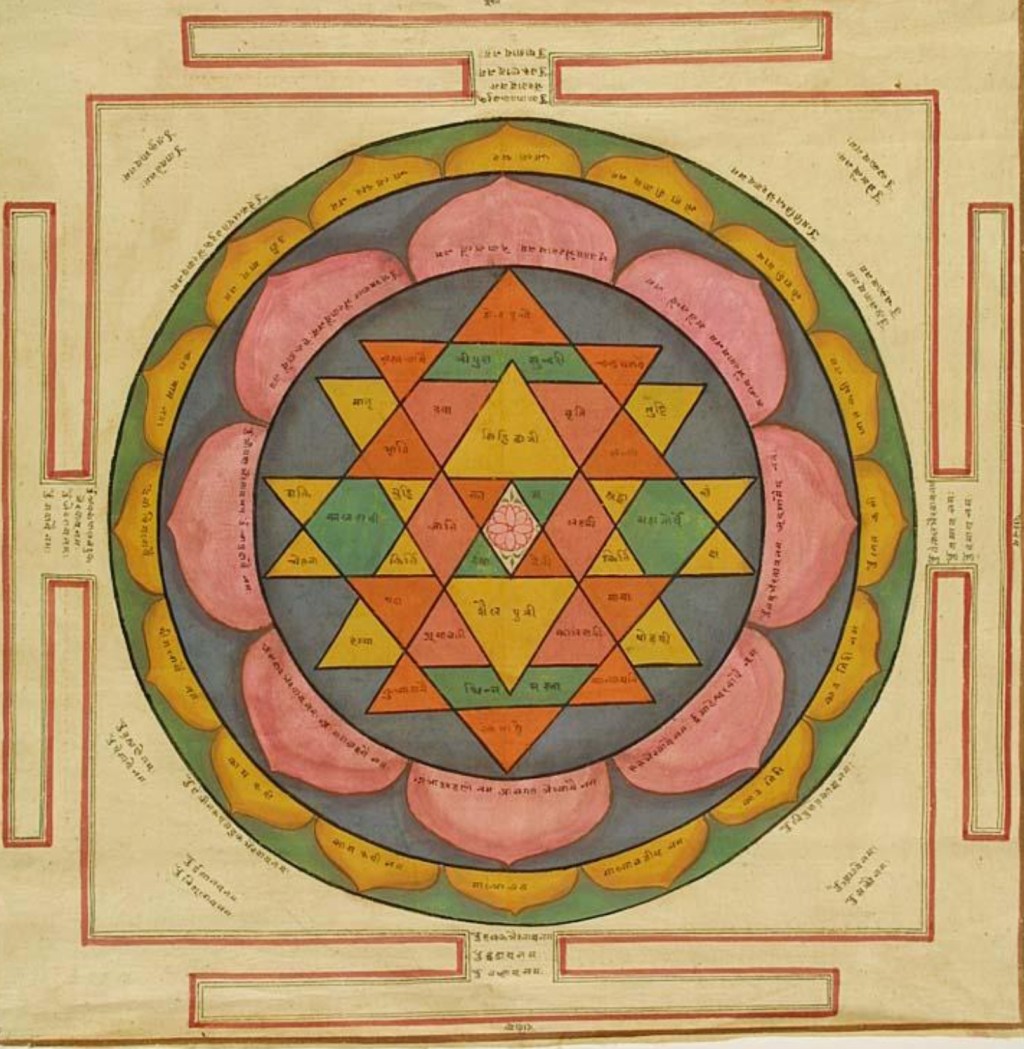
The Sri Yantra is not merely a devotional object or an aid to concentration. It is a diagram of precisely this architecture of awareness.
At its outermost boundary, the square gateway with its four openings, consciousness encounters the world as the realm of differentiated form, the domain of nama and rupa, name and shape, the surface of the Ocean.
Moving inward through the successive rings of lotus petals, sixteen and then eight, awareness begins to withdraw from the multiplicity of outer objects toward the subtler principles that organise them. The field is contracting not toward diminishment but toward depth. The many are resolving into the patterns that generate them.
Then come the nine interlocking triangles at the centre, four Shiva triangles pointing upward and five Shakti triangles pointing downward, their interpenetration generating forty three smaller triangles in a structure of extraordinary geometric precision. These nine triangles are not decorative. They represent the nine primary tattvas of emanation, the levels or scales through which undivided awareness progressively contracts into the experience of a world. To move inward through them is to retrace, in awareness, the movement by which the Ocean became its own waves.
This inward movement is itself named in the tradition. It is called Samhara in its aspect of dissolution or return, and the Yantra encodes it spatially. The outermost registers are Sristi, the outpouring of emanation into multiplicity. The middle registers are Sthiti, the maintenance or dwelling within form. And the movement toward the centre is Samhara, not destruction but the recognition of source.
At the absolute centre of the Sri Yantra is the Bindu, a single dimensionless point.
This is Parasamvit, pure undivided awareness before any act of knowing has separated knower from known. It is the Ocean before the first wave. It is the silence within which all scales of reality are simultaneously held, not as potentials awaiting deployment, but as the living fullness of what consciousness always already is.
The Sri Yantra does not merely represent this understanding. Traversed in meditation from periphery to centre, it enacts it. The practitioner does not think about the scales of reality. They move through them, inward, as awareness itself progressively recognising its own depth.
This is perhaps one of the most beautiful facets of Kashmir Shaivism: reality changes according to the depth from which consciousness is looking. Not because truth itself changes, but because the Ocean reveals different orders of itself depending on the depth of the gaze.
The surface sees events. The depths see movements. The all embracing perspective of Heartmind sees only the Ocean moving within itself.
This is what Abhinavagupta calls Purnahanta, the full I, the recognition in which the absolute knows itself not as an object of contemplation but as the very subject that has always been looking. Not the wave regarding the Ocean from a distance, not even the Ocean regarding itself from within, but the seamless self luminous knowing in which there is no longer any distance between the one who sees and what is seen. The Ocean, awake to itself, with nothing outside it, and nothing hidden within it.



Leave a Reply