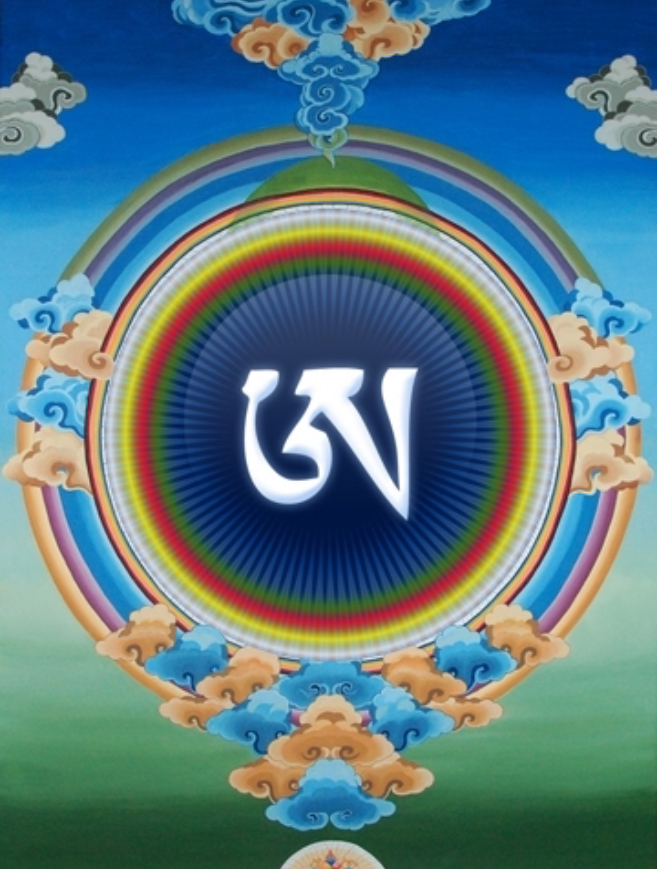
Two of the world’s most sophisticated non-dual philosophical traditions, Kashmir Shaivism and Tibetan Dzogchen, arrive at strikingly similar descriptions of ultimate reality while diverging sharply on one fundamental question: whether that reality can be described as a self.
Kashmir Shaivism, emerging in ninth-century Kashmir through thinkers such as Vasugupta and Abhinavagupta, posits that the ground of all existence is Shiva, a single, non-dual, self-aware consciousness. This consciousness is not static or inert. It is characterised by Spanda, a term meaning vibration or pulsation, which describes the dynamic, alive quality of consciousness perpetually knowing and experiencing itself. Spanda is not something you acquire or achieve. It is what consciousness already is, a self-aware aliveness that gives rise to all manifestation through the interplay of Shiva and Shakti, the dance between transcendent awareness and its creative, expressive power. The physical world, the subtle realms, and all dimensions of experience are understood as genuine manifestations of this one consciousness. Nothing is rejected as illusory. Everything is Shiva expressing itself.
Dzogchen, or the Great Perfection, within Tibetan Buddhism arrives at an equally non-dual vision, describing the fundamental nature of mind as rigpa, pristine, luminous awareness, already perfect, already complete. From a Dzogchen perspective, all of reality, including the physical world and subtler realms, is understood as a projection or manifestation of this mind. The practice is one of direct recognition rather than gradual accumulation, and in this sense it resonates deeply with the Kashmir Shaivism approach to Spanda.
Yet here the traditions diverge. Buddhism is founded on the doctrine of anatman, non-self. The Buddha explicitly rejected the notion of any permanent, unchanging self or essence. Dzogchen, operating within this framework, points to reality as luminous emptiness rather than as a universal self or consciousness. Where Kashmir Shaivism says the ground is Shiva, the one self, Dzogchen says there is no self to be found anywhere, even at the ultimate level.
This apparent contradiction, however, may dissolve under closer examination. Both traditions are describing the same ground from different orientations of perception. If you look at the fundamental nature of reality and identify with it as a unified, aware presence, you will naturally describe it as self. If you look at the same ground and dissolve the boundary of identification entirely, you will describe it as no-self, as pure openness without a centre. Both descriptions are phenomenologically honest. Both map real experiences of that ground. The contradiction exists at the conceptual level, not at the level of direct recognition.
Furthermore, each position carries its own inherent pitfall. Resting in a sense of ultimate self risks subtle ego inflation, the spiritual ego that mistakes its identification with consciousness for final liberation. Resting in non-self risks dissolution, disconnection, and a loss of practical coherence in lived experience. Neither extreme is ultimately satisfying or complete. A dynamic balance between the two, holding presence without clinging to it, and openness without losing groundedness — seems to reflect the actual texture of mature contemplative life more honestly than either position held absolutely.
And yet even this balanced position is itself subject to scrutiny. The moment you assert that both self and non-self are equally valid, you have created a new conceptual framework to inhabit, a new position to cling to. The very act of resolving the dichotomy becomes another subtle trap.
This is where what might be called Manuel Syndrome offers a genuinely liberating perspective. In the beloved BBC comedy Fawlty Towers, the hapless Spanish waiter Manuel is famously instructed by Basil Fawlty in one particular episode to repeat the phrase “I know nothing.” What begins as a comic device points, quite accidentally, to something philosophically profound. Manuel Syndrome, in the contemplative sense, is the stance of radical, honest unknowing not ignorance, but a deliberate and humble refusal to claim final certainty about the nature of reality, including whether that reality is self, non-self, both, or neither.

I believe neither the Buddha nor Abhinavagupta were wrong. Both were pointing at something real from where they stood. But perhaps the wisest acknowledgement is simply that there is consciousness, that much seems undeniable in direct experience, and that any further claim about its ultimate nature, whether self or not-self, balanced or unbalanced, is a conceptual overlay added after the fact. The map is not the territory.
Manuel Syndrome is not nihilism or intellectual laziness. It is an active, alert, humble resting in the recognition that consciousness is present, that it is alive, that it is aware and that what it ultimately is remains, beautifully and honestly, beyond our knowing.
I know nothing, Mr Fawlty. I know nothing.

 heartmind.org.uk
Leave a comment